


Turkey
Highlights for the period January - June 2026
- Growth in lending activity driven by loans in Turkish lira
- Positive performance of recurring revenues
- More negative adjustment for hyperinflation
- Favorable evolution of the net attributable profit
BUSINESS ACTIVITY (1)
(VARIATION AT CONSTANT EXCHANGE RATE COMPARED TO 31-12-25)
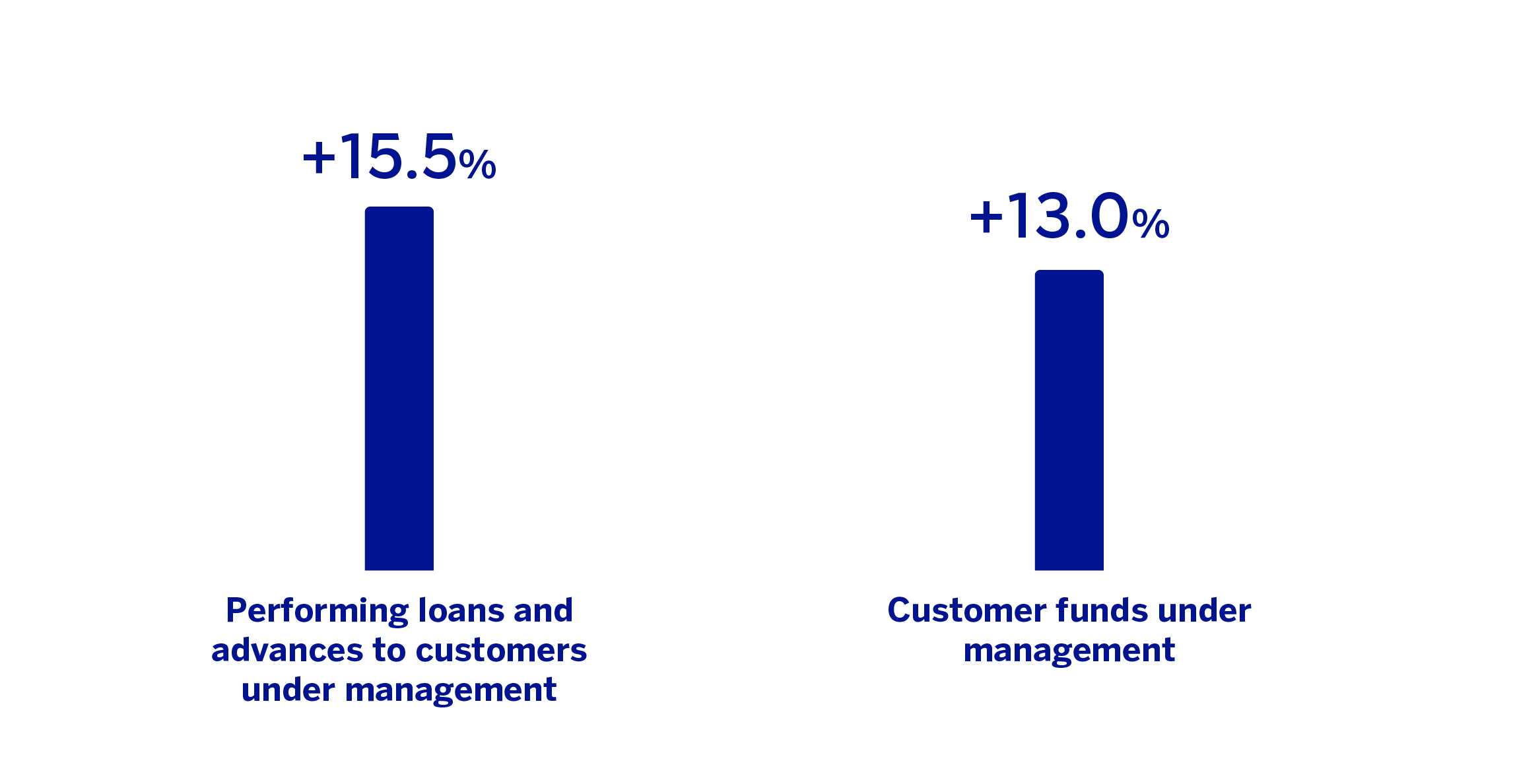
(1) Excluding repos.
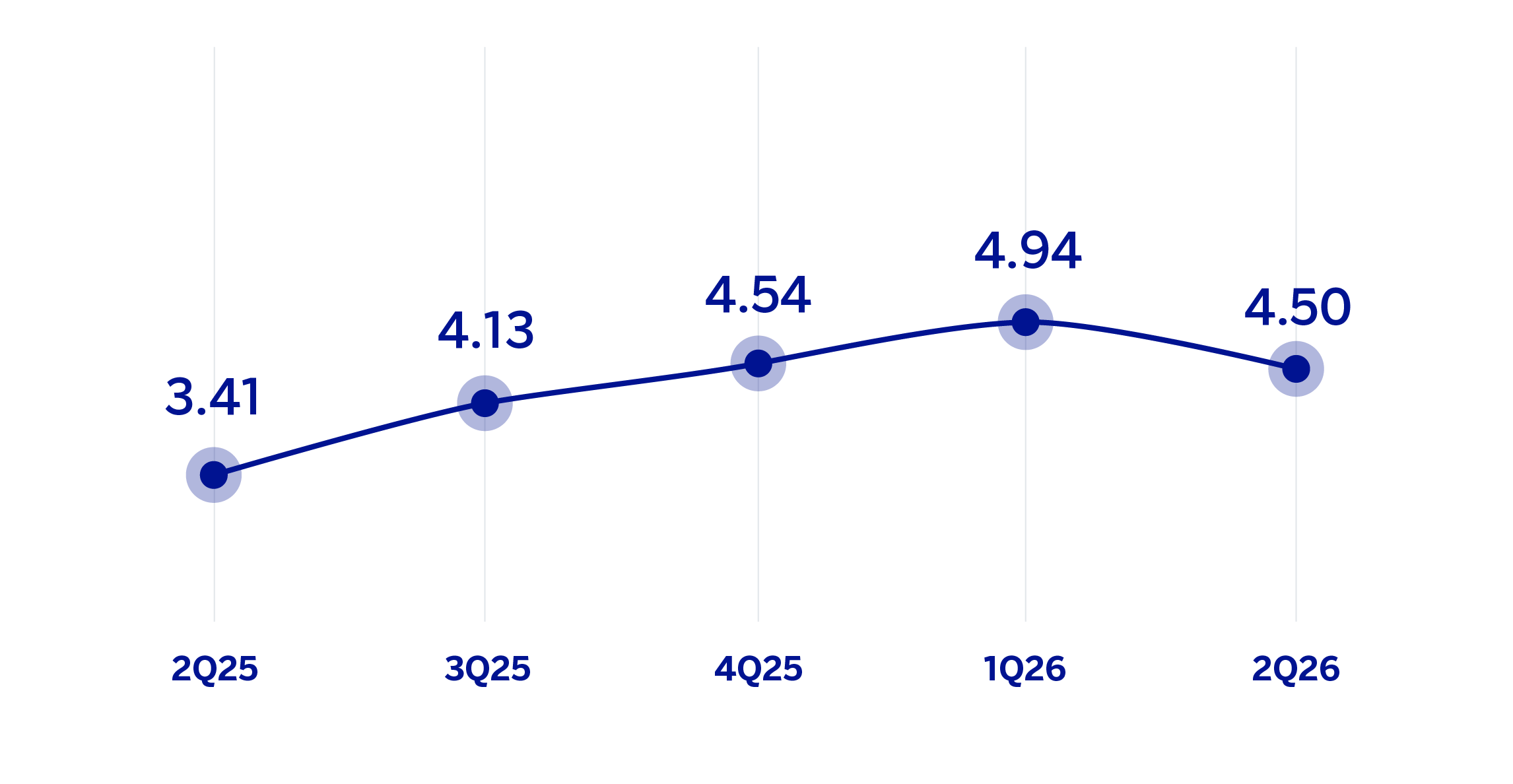
NET INTEREST INCOME / AVERAGE TOTAL ASSETS
(PERCENTAGE AT CONSTANT EXCHANGE RATE)
OPERATING INCOME
(MILLIONS OF EUROS AT CURRENT EXCHANGE RATE)
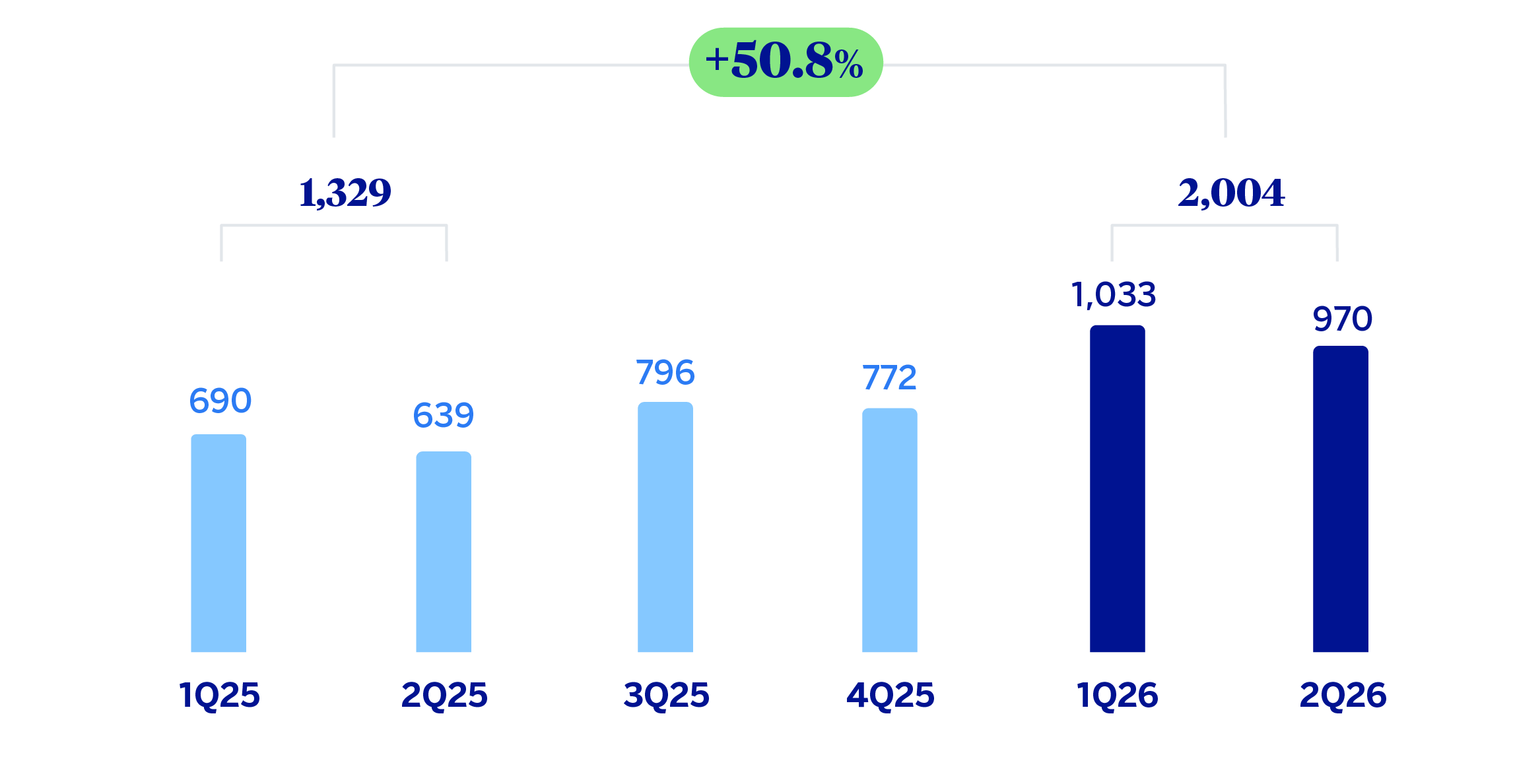
(1) At constant exchange rate: +81.2%.
NET ATTRIBUTABLE PROFIT (LOSS)
(MILLIONS OF EUROS AT CURRENT EXCHANGE RATE)
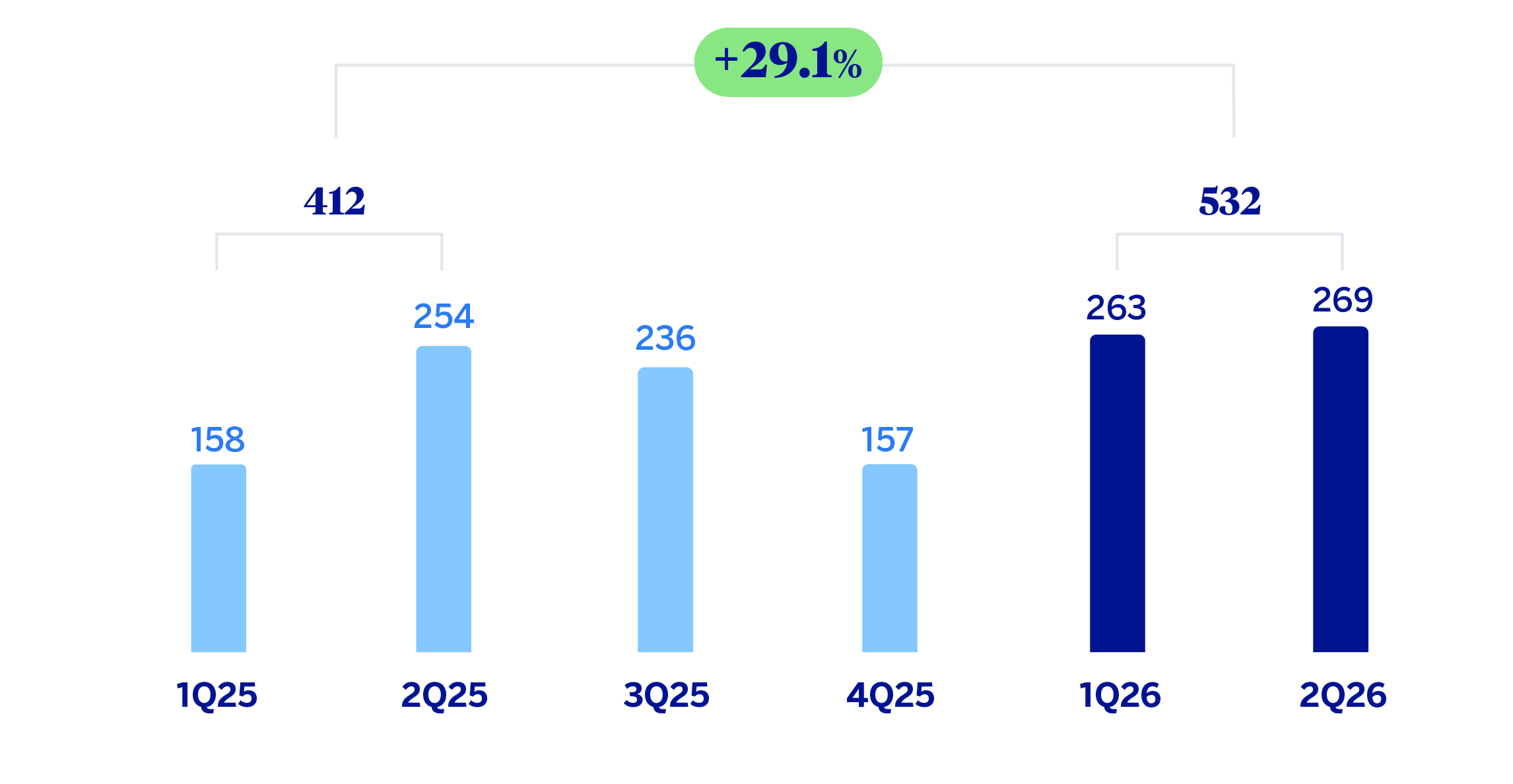
(1) At constant exchange rate: +74.3%.
| FINANCIAL STATEMENTS AND RELEVANT BUSINESS INDICATORS (MILLIONS OF EUROS AND PERCENTAGE) | ||||
|---|---|---|---|---|
| Income statement | 6M26 | 𝚫 % | 𝚫 % (1) | 6M25 (2) |
| Net interest income | 2,152 | 64.7 | 84.1 | 1,307 |
| Net fees and commissions | 1,202 | 13.7 | 28.6 | 1,058 |
| Net trading income | 220 | (0.7) | 8.4 | 221 |
| Other operating income and expenses | (201) | 14.0 | (14.0) | (177) |
| Gross income | 3,372 | 40.0 | 62.8 | 2,409 |
| Operating expenses | (1,369) | 26.8 | 41.7 | (1,080) |
| Personnel expenses | (796) | 29.3 | 45.4 | (616) |
| Other administrative expenses | (438) | 25.2 | 40.8 | (350) |
| Depreciation | (135) | 17.7 | 25.3 | (114) |
| Operating income | 2,004 | 50.8 | 81.2 | 1,329 |
| Impairment on financial assets not measured at fair value through profit or loss | (685) | 68.2 | 90.3 | (407) |
| Provisions or reversal of provisions and other results | (31) | n.s. | n.s. | 11 |
| Profit (loss) before tax | 1,288 | 38.1 | 70.8 | 932 |
| Income tax | (657) | 48.4 | 68.6 | (442) |
| Profit (loss) for the period | 631 | 28.8 | 73.3 | 490 |
| Non-controlling interests | (99) | 27.5 | 67.9 | (78) |
| Net attributable profit (loss) | 532 | 29.1 | 74.3 | 412 |
| Balance sheets | 30-06-26 | 𝚫 % | 𝚫 % (1) | 31-12-25 (2) |
| Cash, cash balances at central banks and other demand deposits | 8,163 | (9.9) | (6.9) | 9,061 |
| Financial assets designated at fair value | 6,209 | 23.9 | 28.8 | 5,010 |
| Of which: Loans and advances | 4 | (77.3) | (76.1) | 18 |
| Financial assets at amortized cost | 79,300 | 10.1 | 15.0 | 72,047 |
| Of which: Loans and advances to customers | 59,446 | 10.6 | 15.7 | 53,745 |
| Tangible assets | 2,066 | 8.5 | 12.0 | 1,905 |
| Other assets | 3,146 | 17.4 | 21.8 | 2,680 |
| Total assets/liabilities and equity | 98,885 | 9.0 | 13.7 | 90,702 |
| Financial liabilities held for trading and designated at fair value through profit or loss | 1,818 | 7.6 | 6.2 | 1,690 |
| Deposits from central banks and credit institutions | 4,466 | 25.3 | 30.0 | 3,565 |
| Deposits from customers | 68,614 | 8.9 | 13.7 | 62,984 |
| Debt certificates | 7,546 | 0.6 | 5.7 | 7,502 |
| Other liabilities | 6,510 | 13.7 | 17.4 | 5,726 |
| Allocated regulatory capital | 9,930 | 7.5 | 12.8 | 9,235 |
| Relevant business indicators | 30-06-26 | 𝚫 % | 𝚫 % (1) | 31-12-25 |
| Performing loans and advances to customers under management (3) | 58,625 | 10.4 | 15.5 | 53,080 |
| Non-performing loans | 3,243 | 16.1 | 22.1 | 2,793 |
| Customer deposits under management (3) | 68,188 | 9.0 | 13.8 | 62,535 |
| Off-balance sheet funds (4) | 27,669 | 5.2 | 10.8 | 26,290 |
| Risk-weighted assets | 77,402 | 8.2 | 13.4 | 71,551 |
| RORWA (5) | 1.7 | 1.4 | ||
| Efficiency ratio (%) | 40.6 | 44.4 | ||
| NPL ratio (%) | 4.1 | 3.9 | ||
| NPL coverage ratio (%) | 75 | 76 | ||
| Cost of risk (%) | 2.36 | 1.94 | ||
| (1) At constant exchange rate. (2) Revised balances with no significant impacts. For more information, please refer to the “Business Areas” section. (3) Excluding repos. (4) Includes mutual funds and pension funds. (5) For more information on the calculation methodology, as well as the calculation of the metric at the consolidated Group level, see Alternative Performance Measures at this report. |
||||
Macro and industry trends
Economic activity has slowed down during the first months of 2026 mainly due to the impact of the conflict in the Middle East on energy prices, trade, tourism, and external financing. Even if there is a certain recovery in growth during the second half of the year, conditional on the easing of geopolitical tensions in the region and the maintenance of selective measures to support activity, BBVA Research forecasts GDP growth for the full year at 3.0%, one percentage point lower than anticipated three months ago.
Regarding the price environment, inflation stood at 32.1% in June, above the figures for the first quarter of 2026 and in line with a slower-than-expected disinflation process. Prices are expected to moderate gradually during the second half of the year, so that the headline rate closes 2026 around 30%, compared to 28-29% in the previous scenario. This would allow a gradual reduction in benchmark interest rates starting in the third quarter, reaching levels of 36% by the end of the year, one point above what was forecast in the previous scenario.
The Turkish banking system continues to be affected by the impact of inflation. The total volume of credit in the system increased by 36.9% year-on-year at the end of May 2026. The stock of credit continues to grow in consumer credit and credit card portfolios (+43.9% year-on-year), in mortgage loans (+37.7% year-on-year) and business lending (+34,2% year-on-year). Total deposits grew by 33.2% year-on-year at the end of May 2026, with growth largely evening out between U.S. dollar deposits (+36.5%) and lira deposits (+31.3%). Dollarization of the system increased slightly to 37.9% in May 2026, from 37.0% a year earlier. As for the system's NPL ratio, it decreased slightly in May 2026 to 2.69%. For their part, capital indicators remain at comfortable levels on the same date.
Unless expressly stated otherwise, all comments below on rates of changes for both activity and results will be presented at constant exchange rates. These rates, together with changes at current exchange rates, can be observed in the attached tables of the financial statements and relevant business indicators. For the conversion of these figures, the end of period exchange rate as of June 30, 2026 is used, reflecting the depreciation by the Turkish lira in the last twelve months. Likewise, the balance sheet, Risk-Weighted Assets (RWA) and the equity are affected. Additionally, the activity, results, and relevant management indicators of the area include, on an ongoing basis, the contribution of the subsidiaries in Romania included in the sale agreement described in the "Highlights" section.
Activity15
The most relevant aspects related to the area's activity during the first half of 2026 were:
Lending activity (performing loans under management) recorded an increase of 15.5% (below the half-year inflation rate, which stood at 17.8%), driven by the growth in Turkish lira loans (15.3%). This growth was largely supported by the performance of credit cards (+18.0%). Foreign currency loans (in US dollars) increased slightly by 0.8%.
Customer deposits (69.4% of the area's total liabilities as of June 30, 2026) remained the main source of funding for the balance sheet and increased by +13.8% favored by the performance of Turkish lira time deposits (+28.3%), which represent an 85% of total customer deposits in local currency. Thus, as of June 30, 2026, Turkish lira deposits accounted for 67% of total customer deposits in the area. For its part, off-balance sheet funds grew by 10.8%.
The most relevant aspects related to the area’s activity in the second quarter of 2026 were:
Lending activity (performing loans under management) increased by 8.1% (above the quarterly inflation rate, which stood at +7.0%), mainly driven by the growth in Turkish lira loans (+7.7%, boosted by the growth in credit cards) and, to a lesser extent, by the slight increase of U.S. dollar loans (+0.5%), boosted by the increase in activity with customers focused on foreign trade (with natural hedging of exchange rate risk).
In terms of asset quality, the NPL ratio remains stable at 4.1% (2 basis points below the level reached at the end of March) supported by the increase in activity and where NPL entries, mainly from the retail portfolio, have been partially offset by recoveries and sales of impaired portfolios. On the other hand, the NPL coverage ratio recorded an increase of 136 basis points during the quarter, standing at 75% as of June 30, 2026.
In the favorable evolution of customer funds during the quarter (+7.6%), the growth in Turkish lira time deposits (+20.6%) stood out once again, which comfortably offset the decline in demand deposits in foreign currency.
Results
Turkey reached a net attributable profit of €532 million in the first half of 2026, which compares very favorably with the result achieved in the same period of the previous year, as a result mainly of the good performance of recurring revenues in banking business (net interest income and net fees and commissions).
As mentioned above, the year-on-year comparison of the accumulated income statement at the end of June 2026 at current exchange rate is affected by the depreciation of the Turkish lira over the past twelve months (-12.4%), with a less pronounced drop in the quarter (-3.8%). To isolate this effect, the highlights of the results of the first half of 2026 at constant exchange rates are summarized below:
Net interest income experienced a year-on-year growth, mainly driven by the dynamism of lending activity and the increased remuneration of certain Turkish lira reserves by the central bank, as well as a decrease in the cost of wholesale funding.
Net fees and commissions recorded a significant increase, driven by the solid performance in fees and commissions associated with payment methods, followed by those related to asset management, insurances, guarantees and brokerage activity.
Increase in NTI, originating from higher revenues from derivatives and securities, as well as in Global Markets results, partially offset by higher losses from the foreign exchange positions.
The other operating income and expenses line had a balance of €-201 million, which represents a higher expense compared to the same period of the previous year. This line incorporates, among others, the loss on the net monetary position, together with its partial offset by the income derived from inflation-linked bonds (CPI linkers). The net impact of both effects was more negative in the first half of 2026, compared with the same period of 2025 and was partially offset by the results of certain subsidiaries of Garanti BBVA and the performance of the insurance business, whose contribution was increased in both cases.
Operating expenses continued to grow, although below the growth in gross income, with the consequent improvement in efficiency. In personnel expenses, the increase was centered on fixed remuneration to the staff, associated with salary reviews in the context of high inflation. For their part, general expenses also grew, highlighting the higher technology expenses.
Regarding the impairment on financial assets, higher provisions were recorded, which is explained by the growth of the activity, higher requirements in retail portfolios and lower releases in the wholesale portfolio. Meanwhile, the accumulated cost of risk as of June 30, 2026 stood at 2.36%, a decrease of -16 basis points compared to the quarterly cost of risk of the previous quarter.
In the second quarter of 2026, the net attributable profit of Turkey, at current exchange rates, stood at €269 million, which represents an improvement compared to the previous quarter, mainly driven by the performance of credit card fees, which offset the decrease in the net interest income and NTI, as well as higher operating expenses.
15 The variation rates of loans in Turkish lira and loans in foreign currency (U.S. dollars) are calculated based on local activity data and refer only refer to Garanti Bank and therefore exclude the subsidiaries of Garanti BBVA, mainly in Romania and Netherlands.
Read legal disclaimer of this report.