


Risk management
At a global level, although the restoration of trade flows in the Strait of Hormuz and the correction of energy prices have improved the balance of risks, the persistence of geopolitical tensions keeps uncertainty high and constitutes a relevant risk factor. The evolution of these international tensions adds complexity to the global macroeconomic environment, potentially generating additional pressures on inflation, financial conditions, and economic activity. Therefore, the macroeconomic outlook of the geographical areas in which the Group operates could be influenced by the duration and intensity of these factors, with differentiated impacts by country.
In Spain, a moderation of growth is expected compared to the previous year, in a context where the evolution of inflation and interest rates will continue to be relevant, with a sound level of solvency and liquidity in the system. In Mexico, activity has been weaker than expected, which has led to a downward revision of the growth forecast, in a context in which inflation and the monetary policy path will continue to be determining factors, with a banking system that continues to show credit growth. Meanwhile, in Turkey, macroeconomic developments remain conditioned by inflation, the management of monetary and fiscal policies, and the volatility of the environment. Lastly, in South America, a heterogeneous performance across countries is expected, in a context of differing trends in growth, inflation, and interest rates.
Within this framework, the Group continuously monitors the evolution of the macroeconomic and geopolitical environment, as well as its potential impact on the evolution of credit risk, in accordance with the applicable accounting and prudential regulations.
Credit risk metrics
The Group periodically reviews its individual estimates and its models for the collective estimate of expected losses as well as the effect of macroeconomic scenarios on them. Although these updates incorporate the best information available at any given time, they may not fully reflect the most recent developments in the economic environment, especially in contexts of high uncertainty and volatility or very recent events still under development.
For the estimation of expected losses, the models include individual and collective estimates, taking into account the macroeconomic forecasts as established in IFRS 9. Thus, the estimate at the end of the quarter includes the effect on expected losses of updating macroeconomic forecasts. The Group may supplement the expected losses to account for the effects that may not be included in the calculations referred to above, either by considering additional risk factors, or by the incorporation of sectorial particularities or particularities that may affect a set of operations or borrowers, following a formal internal approval process established for this purpose.
As of June 30, 2026 and as of December 31, 2025, the Group had not recorded any relevant adjustments to the expected loss estimation models.
BBVA Group's credit risk indicators
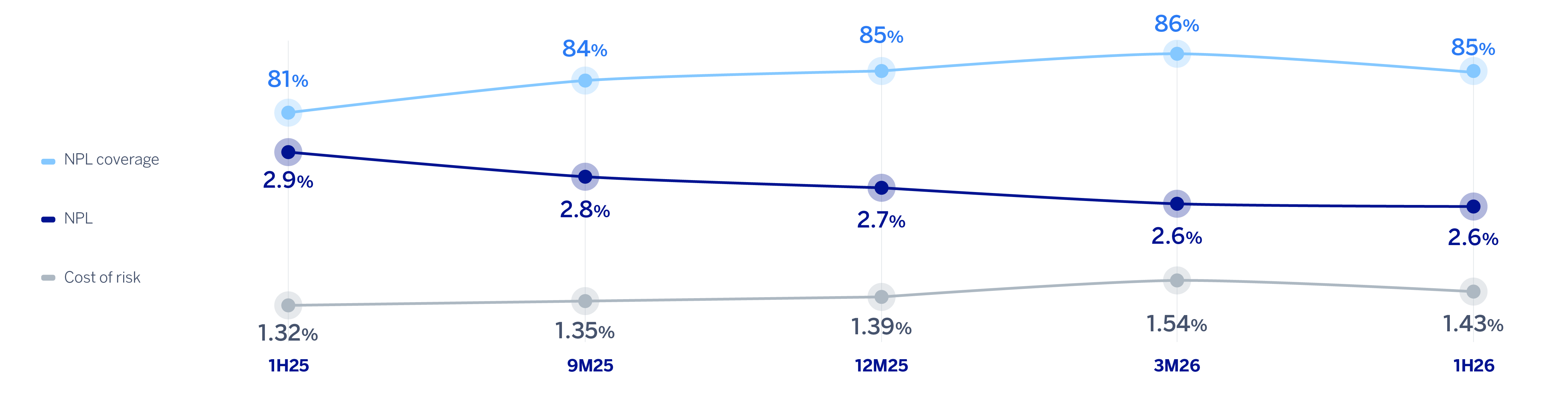
The following chart shows the evolution of the Group's risk metrics from the first half of 2025:
NPL AND NPL COVERAGE RATIOS AND COST OF RISK (PERCENTAGE)
The evolution of the Group’s main credit risk indicators is summarized below:
In terms of asset quality, the NPL ratio stood at 2.62% as of June 30, 2026, which is an improvement of 3 basis points compared to the previous quarter, and an improvement of 28 basis points when compared to the end of June 2025, both comparisons driven by the performance of lending, which showed an increase in all business areas.
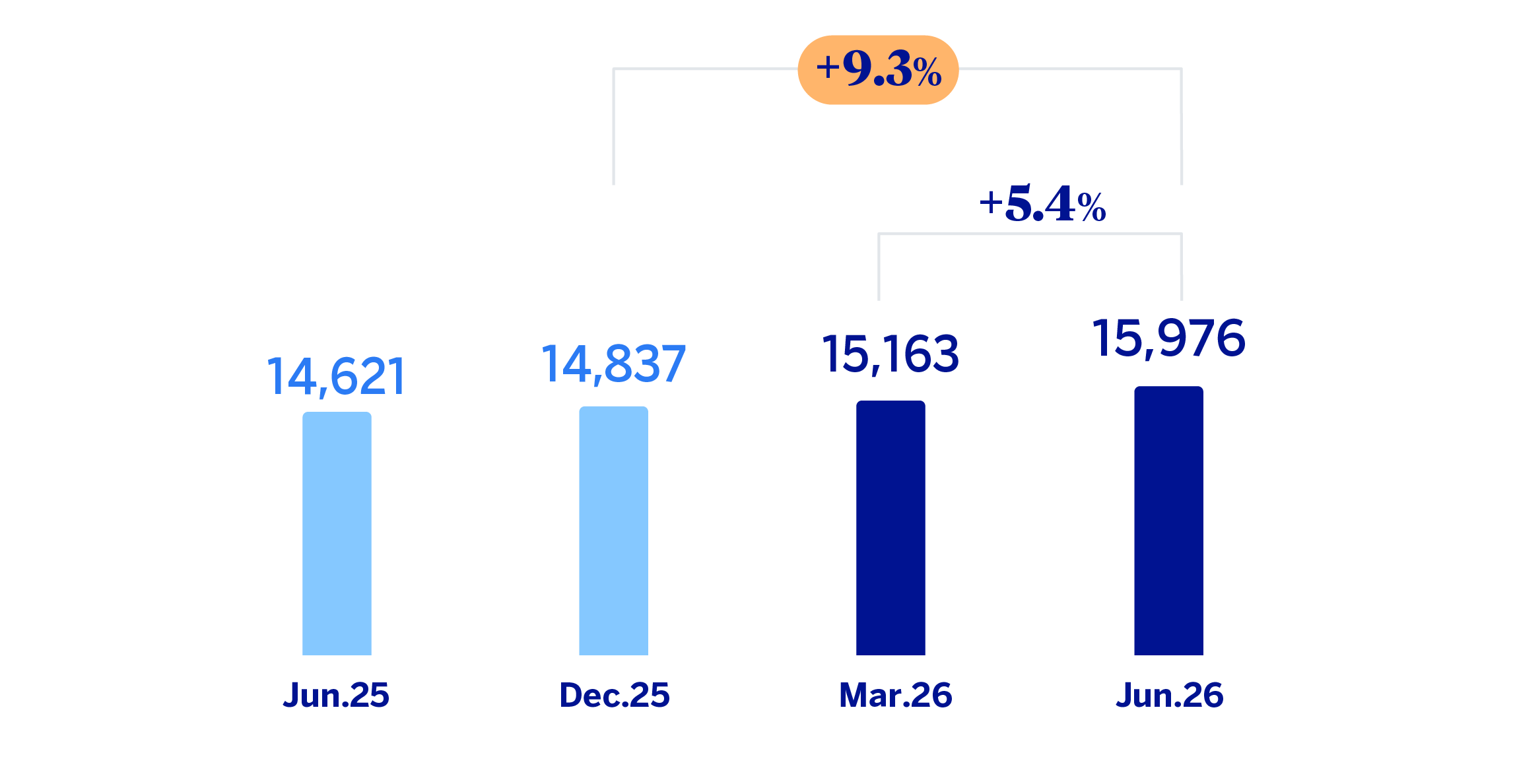
NON-PERFORMING LOANS (MILLIONS OF EUROS)
PROVISIONS (MILLIONS OF EUROS)
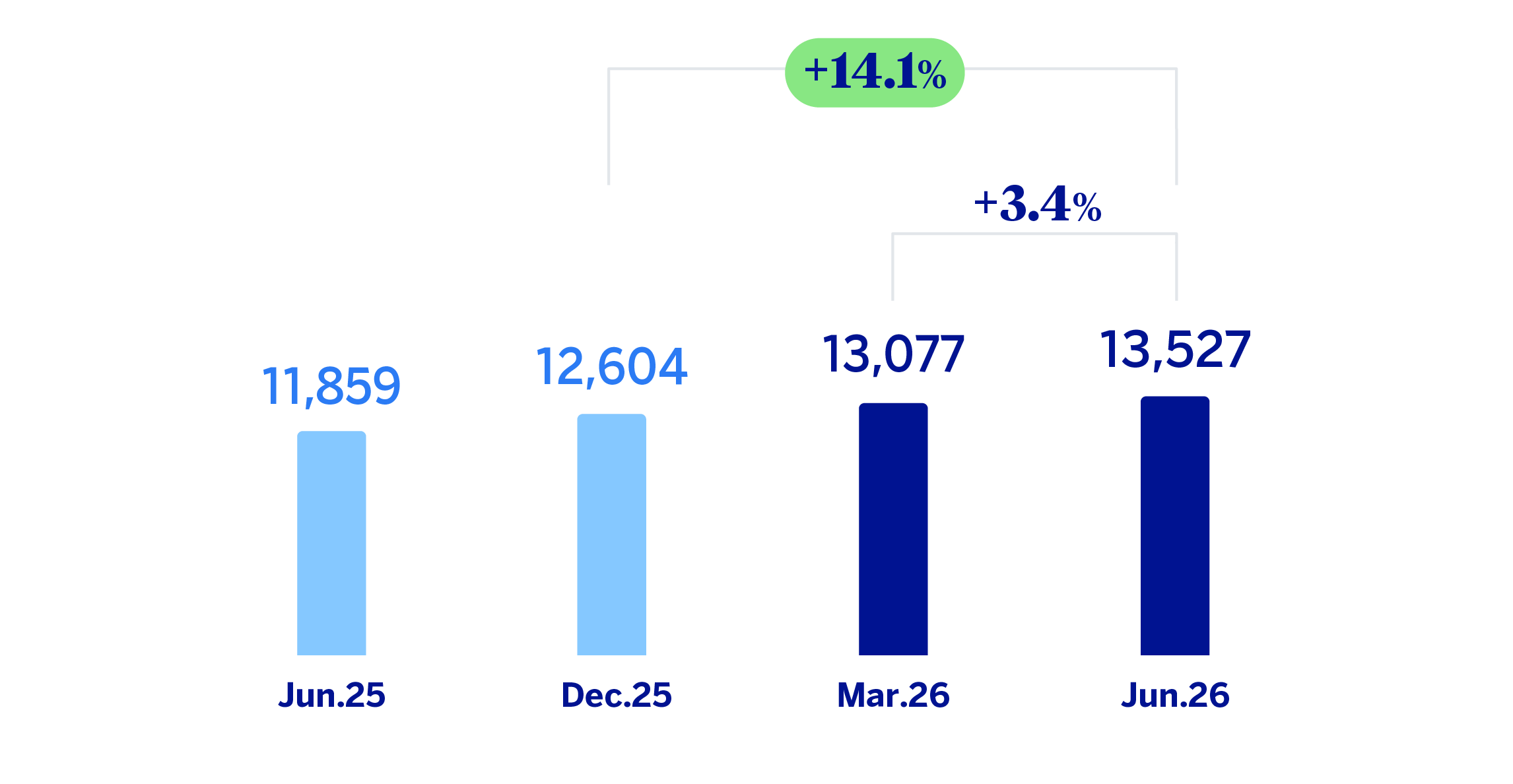
Credit risk increased by 6.4% in the second quarter of the year (+5.5% at constant exchange rates) with generalized growth in all business areas. In the last twelve months, the growth has exceeded double digits, standing at 20.8% (+18.8% at constant exchange rates), showing greater dynamism than in the same period of 2025.
The balance of non-performing loans increased by 5.4% in the second quarter of 2026 at the Group level, and of 9.3% in year-on year terms (+7.3% at constant exchange rates). At constant exchange rates, the quarterly variation stood at 4.8%, focused on Mexico, Rest of Business and Turkey, as a result of the increase in non-performing loans in the retail and wholesale portfolio.
The NPL coverage ratio ended June 2026 at 85%, stable compared to the end of the previous year, with a decrease of 157 basis points compared to the previous quarter (and growth of 356 basis points compared to the end of June 2025).
The cumulative cost of risk as of June 30, 2026 stood at 1.43%, which represents an increase of 4 basis points compared to the cost of risk at the end of 2025 and 11 basis points below the end of the previous quarter.
| CREDIT RISK (1) (MILLIONS OF EUROS) | |||||
|---|---|---|---|---|---|
| 30-06-26 (2) | 31-03-26 (2) | 31-12-25 | 30-09-25 | 30-06-25 | |
| Credit risk | 608,755 | 572,273 | 547,184 | 516,896 | 503,733 |
| Stage 1 | 555,789 | 521,734 | 498,750 | 470,097 | 456,385 |
| Stage 2 | 36,990 | 35,375 | 33,597 | 32,464 | 32,727 |
| Stage 3 (non-performing loans) | 15,976 | 15,163 | 14,837 | 14,335 | 14,621 |
| Provisions | 13,527 | 13,077 | 12,604 | 12,031 | 11,859 |
| Stage 1 | 2,672 | 2,578 | 2,467 | 2,450 | 2,423 |
| Stage 2 | 2,109 | 2,155 | 2,005 | 1,938 | 1,864 |
| Stage 3 (non-performing loans) | 8,747 | 8,343 | 8,133 | 7,643 | 7,572 |
| NPL ratio (%) | 2.6 | 2.6 | 2.7 | 2.8 | 2.9 |
| NPL coverage ratio (%) (3) | 85 | 86 | 85 | 84 | 81 |
| (1) Includes gross loans and advances to customers plus guarantees given. (2) Figures without considering the classification of non-current assets held for sale (NCA&L) reached from the agreement to sell the Romanian subsidiary of Garanti BBVA. (3) The NPL coverage ratio includes the valuation adjustments for credit risk throughout the expected residual life in those financial instruments that have been acquired (mainly originating from the acquisition of Catalunya Banc, S.A.). If these valuation corrections had not been taken into account, the NPL coverage ratio would have stood at 84% as of June 30, 2026. |
|||||
| NON-PERFORMING LOANS EVOLUTION (MILLIONS OF EUROS) | |||||
|---|---|---|---|---|---|
| 2Q26 (1)(2) | 1Q26 (2) | 4Q25 | 3Q25 | 2Q25 | |
| Beginning balance | 15,163 | 14,837 | 14,335 | 14,621 | 14,296 |
| Entries | 4,094 | 3,359 | 3,450 | 3,600 | 3,219 |
| Recoveries | (2,000) | (1,587) | (1,722) | (1,754) | (1,677) |
| Net variation | 2,094 | 1,771 | 1,729 | 1,846 | 1,542 |
| Write-offs | (1,266) | (1,244) | (1,182) | (1,065) | (957) |
| Exchange rate differences and other | (15) | (201) | (45) | (1,067) | (261) |
| Period-end balance | 15,976 | 15,163 | 14,837 | 14,335 | 14,621 |
| Memorandum item: | |||||
| Non-performing loans | 15,521 | 14,709 | 14,346 | 13,813 | 14,131 |
| Non performing guarantees given | 455 | 455 | 491 | 522 | 490 |
| (1) Preliminary data. (2) Figures without considering the classification of non-current assets held for sale (NCA&L) reached from the agreement to sell the Romanian subsidiary of Garanti BBVA. |
|||||
Structural risks
Liquidity and funding
Liquidity and funding management at BBVA is aimed at driving sustained growth of the banking business, through access to a wide variety of alternative sources of funding and assuring optimal term and cost conditions. BBVA's business model, risk appetite framework and funding strategy are designed to reach a solid funding structure based on stable customer deposits, mainly retail (granular). As a result of this model, deposits have a high degree of insurance in each geographical area, close to 50% in Spain and Mexico. It is important to note that, given the nature of BBVA's business, lending is mainly financed through stable customer funds.
One of the key elements in the BBVA Group's liquidity and funding management is the maintenance of large high-quality liquidity buffers in all geographical areas. Thus, the Group has maintained during the last 12 months an average volume of high-quality liquid assets (HQLA) of €129.8 billion, of which 98% corresponded to maximum quality assets (level 1 in the liquidity coverage ratio, LCR).
Due to its subsidiary-based management model, BBVA is one of the few major European banks that follows a Multiple Point of Entry (MPE) resolution strategy: the parent company sets the liquidity policies, but the subsidiaries are self-sufficient and responsible for managing their own liquidity and funding (taking deposits or accessing the market with their own rating). This strategy limits the spread of a liquidity crisis among the Group's different areas and ensures the adequate transmission of the cost of liquidity and financing to the price formation process.
The BBVA Group maintains a solid liquidity position in every geographical area in which it operates, with ratios well above the minimum required:
The LCR requires banks to maintain a volume of high-quality liquid assets sufficient to withstand liquidity stress for 30 days. BBVA Group's consolidated LCR remained comfortably above 100% during the first half of 2026 and stood at 145% as of June 30, 2026. It should be noted that, given the MPE nature of BBVA, this ratio limits the numerator of the LCR for subsidiaries of BBVA S.A. to 100% of their net outflows, therefore, the resulting ratio is below that of the individual units (the LCR of the main components was 180% in BBVA, S.A., 149% in Mexico and 156% in Turkey). Without considering this restriction, the Group's LCR ratio was 174%.
The net stable funding ratio (NSFR) requires banks to maintain a stable funding profile in relation to the composition of their assets and off-balance sheet activities. The BBVA Group's NSFR ratio stood at 125% as of June 30, 2026.
The breakdown of these ratios in the main geographical areas in which the Group operates is shown below:
| LCR AND NSFR RATIOS (PERCENTAGE. 30-06-26) | ||||
|---|---|---|---|---|
| BBVA, S.A. | Mexico | Turkey (1) | South America | |
| LCR | 180 | 149 | 156 | All countries >100 |
| NSFR | 116 | 129 | 141 | All countries >100 |
| (1) Garanti Bank only. | ||||
During the first half of 2026, the conflict in Iran has created an environment of greater uncertainty and volatility in the markets, with central banks maintaining a cautious stance regarding its potential implications.
In this context, BBVA maintains a solid liquidity position across all its geographic areas, with no signs of stress. As previously shown, the main liquidity indicators (LCR, NSFR, and internal metrics) remain at comfortable levels, well above regulatory thresholds. Furthermore, the active and prudent balance sheet management, together with the diversification of funding sources, strengthens the Group's ability to face different scenarios without compromising its liquidity position.
Apart from the above, the most relevant aspects related to the main geographical areas are the following:
BBVA, S.A. has maintained a strong position with a large high-quality liquidity buffer, maintaining at all times the regulatory liquidity metrics well above the set minimums. During the first half of 2026, significant growth has been observed in lending activity, driven primarily by the wholesale segment, in an environment of moderate growth in deposits. This development has not put pressure on the liquidity position.
BBVA Mexico continues to show a solid liquidity situation, even though the credit gap has widened in the first half of the year due to the strength of lending, especially in local currency.
In Turkey, Garanti BBVA maintained an adequate liquidity situation in the first half of 2026. The lending gap has improved favored by the growth of deposits in the Turkish lira. On the other hand, a deterioration has been observed in the foreign currency credit gap due to the outflows of deposited balances.
In South America, the liquidity situation has also remained adequate throughout the region in the first half of 2026. BBVA Argentina maintains an adequate liquidity position. In the first half, the credit gap improved in local currency thanks to the growth in deposits in both the retail and wholesale segments. In US dollars, deposit growth has been below credit growth, which occurred mostly throughout the first quarter. In BBVA Colombia, the liquidity situation remains stable with a narrowing credit gap, and deposit growth outpaced lending. In BBVA Peru, the liquidity position remains solid, with an improved credit gap in the half-year thanks mainly to the good performance of retail deposits.
The main wholesale financing transactions carried out by the BBVA Group during the first half of 2026 are listed below.
| Issuer | Type of issue | Date of issue | Nominal (millions) | Currency | Equivalent in euros (1) | Coupon | Maturity Date |
| BBVA, S.A. | Senior non-preferred | Jan-26 | 1,250 | EUR | 1,250 | 3.750% | Jan-36 |
| Senior non-preferred | Jan-26 | 750 | EUR | 750 | Euribor 3m+55 bps | Jan-29 | |
| Senior non-preferred | Mar-26 | 1,000 | USD | 878 | 4.150% | Mar-29 | |
| Senior non-preferred | Mar-26 | 1,000 | USD | 878 | 5.127% | Mar-36 | |
| Senior non-preferred | Mar-26 | 500 | USD | 439 | SOFR+88 bps | Mar-29 | |
| AT1 (2) | May-26 | 1,000 | USD | 878 | 7.125% | Perpetual | |
| Senior non-preferred | May-26 | 1,250 | USD | 1,097 | 4.968% | May-31 | |
| Covered bond * | Jun-26 | 1,000 | EUR | 1,000 | 3.125% | Jun-33 | |
| Covered bond * | Jun-26 | 1,250 | EUR | 1,250 | 2.875% | Jun-29 | |
| Senior non-preferred | Jun-26 | 1,250 | EUR | 1,250 | 3.375% | Jun-31 | |
| BBVA Mexico | Senior | Feb-26 | 8,876 | MXN | 446 | 9.260% | Jan-36 |
| Senior | Feb-26 | 6,124 | MXN | 308 | TIIE+32 bps | Jul-29 | |
| Senior USD | Feb-26 | 16 | USD | 14 | 4.190% | Sep-28 | |
| Senior USD | Jun-26 | 1,000 | USD | 878 | 5.400% | Jun-31 | |
| Garanti BBVA | Senior Debt MTNs (Medium term notes) | Several | 1,382 | EUR | 1,382 | Several | Several |
| Syndicated loan | Jun-26 | 33 | USD | 29 | SOFR+125 bps | Jun-27 | |
| Syndicated loan | Jun-26 | 24 | EUR | 24 | Euribor+110 bps | Jun-27 | |
| Syndicated loan | Jun-26 | 105 | USD | 92 | SOFR+175 bps | Jun-28 | |
| Syndicated loan | Jun-26 | 40 | EUR | 40 | Euribor+160 bps | Jun-28 | |
| Syndicated loan | Jun-26 | 88 | USD | 77 | SOFR+200 bps | Jun-29 | |
| BBVA Argentina | Senior Debt | Feb-26 | 37 | USD | 32 | 5.000% | Aug-27 |
| Senior Debt | Mar-26 | 45,457 | ARS | 27 | TAMAR +350 bps | Mar-27 | |
| Senior Debt | May-26 | 48 | USD | 42 | 5.000% | May-28 | |
| Senior Debt | May-26 | 25 | USD | 22 | 3.250% | May-27 | |
| Senior Debt | May-26 | 83,914 | ARS | 50 | TAMAR +325 bps | May-27 | |
| Senior Debt | Jun-26 | 161,298 | ARS | 96 | TAMAR +325 bps | Jun-27 | |
| BBVA Peru | Tier 2 (3) | Mar-26 | 300 | PEN | 77 | 6.750% | Mar-38 |
| (1) Equivalent in euros at the closing exchange rate of the period. (2) First Reset Date in May 2033. (3) First Reset Date in March 2033. |
|||||||
* On June 16, BBVA, S.A. carried out a dual-tranche issue of mortgage-covered bonds for a total of €2.25 billion. Of the first tranche, with a maturity of three years, it has placed €1.25 billion, at a price of mid-swap +14 basis points. Of the second tranche, with a maturity of seven years, it has placed €1 billion, at a price of mid-swap +27 basis points.
During the first half of 2026, BBVA, S.A. carried out the early redemption of two issuances. First, on January 15, 2026, it carried out the early redemption of a green AT1 issuance made on July 15, 2020, for a combined nominal amount of €1 billion, a decision that was communicated to the market on December 17, 2025. Likewise, on March 24, 2026, BBVA, S.A. carried out the early redemption of a senior preferred bond issuance originally issued on March 24, 2021, for a total aggregate nominal amount of €1 billion, a decision that was disclosed to the market on February 11, 2026. In addition, on July 15, 2026, the early redemption of a subordinated bond issuance was carried out for a combined nominal amount of 300 million pounds sterling, a decision that had been communicated to the market on June 9.
Foreign exchange
Foreign exchange risk management aims to reduce both the sensitivity of the capital ratios to currency movements, as well as the variability of profit attributed to currency movements.
During the second quarter of 2026, the Group's main currencies showed an uneven performance against the euro. Due to its relevance for the Group, it should be noted the performance of the Mexican peso, which appreciated by 4.1% against the euro. In the case of the US dollar, the currency registered a moderate appreciation of 0.9% against the euro. For its part, the Turkish lira and the Argentine peso depreciated by 3.8% and 4.9% against the euro, respectively (although, in real terms, both currencies registered an appreciation against the euro), while the currencies of the rest of the main countries in South America closed the half-year with an appreciation against the euro, of 3.5% in the case of the Peruvian sol, 1.9% in the case of the Chilean peso and 7.5% in the case of the Colombian peso.
| EXCHANGE RATES | |||||||
|---|---|---|---|---|---|---|---|
| Period-end exchange rates | Average exchange rates | ||||||
| Currency/Euro 30-06-26 | 𝚫 % of the currency against 31-03-26 | 𝚫 % of the currency against 30-06-25 | 𝚫 % of the currency against 31-12-25 | Currency/Euro 6M26 | 𝚫 % of the currency against 6M26 |
||
| U.S. dollar | 1.1394 | 0.9 | 2.9 | 3.1 | 1.1665 | (6.3) | |
| Mexican peso | 19.9030 | 4.1 | 11.0 | 6.1 | 20.3788 | 7.0 | |
| Turkish lira (1) | 53.1642 | (3.8) | (12.4) | (5.0) | — | — | |
| Peruvian sol | 3.8876 | 3.5 | 6.5 | 1.6 | 3.9733 | 1.1 | |
| Argentine peso (1) | 1,687.06 | (4.9) | (17.3) | 1.6 | — | — | |
| Chilean peso | 1,050.91 | 1.9 | 4.4 | 1.4 | 1,041.65 | 0.2 | |
| Colombian peso | 3,923.63 | 7.5 | 21.6 | 12.5 | 4,262.51 | 7.6 | |
| (1) According to IAS 21 "The effects of changes in foreign exchange rates", the year-end exchange rate is used for the conversion of the Turkey and Argentina income statement. | |||||||
In relation to the hedging of capital ratios, BBVA aims to hedge between 50% and 70% of the capital excess of the currencies of its main subsidiaries. The sensitivity of the Group's CET1 ratio to 10% depreciations in major currencies is estimated at: +14 basis points for the U.S. dollar, -15 basis points for the Mexican peso and -3 basis points for the Turkish lira13. With regard to the hedging of results, BBVA hedges between 40% and 50% of the aggregate net attributable profit it expects to generate in the next 12 months. For each currency, the final amount hedged depends, among other factors, on its expected future evolution, the costs and the relevance of the income related to the Group's results as a whole.
Interest rate
Interest rate risk management seeks to limit the impact that BBVA may suffer, both in terms of results (short-term) and economic value (long-term), from adverse movements in the interest rate curves in the various currencies in which the Group operates. BBVA carries out this work through an internal procedure, pursuant to the guidelines established by the European Banking Authority (EBA), with the aim of analyzing the potential impact that could derive from a range of scenarios on the Group's different balance sheets.
Risk measurement is based on assumptions intended to realistically mimic the behavior of the balance sheet. The assumptions regarding the behavior of accounts with no explicit maturity and prepayment estimates are especially relevant. These assumptions are reviewed and adapted, at least once a year according to the evolution in observed behaviors.
At the aggregate level, BBVA continues to maintain a moderate risk profile in line with the target set in the changing interest rate cycle environment maintaining positive sensitivity to interest rate rises in net interest income.
The first half of 2026 has been marked by the conflict in Iran and the news flow regarding the potential signing of the peace agreement. This has led to high volatility in the yield curves as well as in the expectations of the decisions that central banks could make to fight the increase in inflation. In the first six months of the year, there have been spikes in yields in the interest rate curves in the United States, Europe and Turkey, especially in the short end in the United States and Europe. In Mexico, on the other hand, the curves fell, as in Argentina, Colombia and Peru, the latter two positively impacted by the outcome of their respective electoral processes. In this respect, the valuation of ALCO14 portfolios has shown a mixed performance in the first half of 2026.
By geographical areas:
Spain has a balance sheet characterized by a lending portfolio with a high proportion of variable-rate loans (mortgages and corporate lending) and liabilities composed mainly by customer demand deposits. The ALCO portfolio acts as a management lever and hedge for the balance sheet, mitigating its sensitivity to interest rate fluctuations. The exposure of the net interest income to movements in interest rates remains limited. In June 2026, the ECB carried out its first interest rate hike in three years, with an increase of 25 basis points. Thus, the benchmark interest rate in the euro area stood at 2.25% at the end of June 2026, the rate on the deposit facility at 2.40% and the rate on the marginal lending facility at 2.65%.
Mexico continues to show a balance between fixed and variable interest rates balances, which results in a limited sensitivity to interest rates fluctuations. Among the assets that are most sensitive to interest rate changes, the commercial portfolio stands out, while consumer and mortgage portfolios are mostly at a fixed rate. With regard to customer funds, the high proportion of non-interest-bearing deposits, which are insensitive to interest rate movements, should be highlighted. The ALCO portfolio is invested primarily in fixed-rate sovereign bonds with limited durations. The monetary policy rate stood at 6.50% at the end of June 2026, 50 basis points below the year-end level for 2025.
In Turkey, the sensitivity of net interest income to rates remains limited in both local and foreign currencies, thanks to the bank's management, with a low repricing gap between loans and deposits. The Central Bank of the Republic of Turkey (CBRT) continued its monetary easing process at the beginning of the year, supported by improved inflation, setting the monetary policy rate at 37.0% in January 2026 (a decrease of 100 basis points since the end of December 2025). However, the outbreak of the conflict in Iran led the institution to raise the effective cost of financing toward the upper limit of its corridor (40%) in response to geopolitical tensions and their inflationary impact, a level at which it remains at the close of June.
In South America, the sensitivity of net interest income continues to be limited, since most of the countries in the area have a fixed/variable composition stable between assets and liabilities. In addition, in balance sheets with several currencies, the interest rate risk is managed for each of the currencies, showing a very low level of exposure. Regarding benchmark interest rates, in Argentina, the central bank abandoned the official interest rate as a monetary anchor and began to regulate the monetary base using other tools such as setting reserve requirements or intervening in the foreign exchange market for its management. In Colombia, the reference rate stood at 12% at the end of June 2026, 275 basis points above the end of 2025, with an increase of 75 basis points in the second quarter of 2026. In Peru, the official monetary policy rate closed June 2026 at 4.25%, unchanged with respect to the end of the previous year.
| INTEREST RATES (PERCENTAGE) | |||||
|---|---|---|---|---|---|
| 30-06-26 | 31-03-26 | 31-12-25 | 30-09-25 | 30-06-25 | |
| Official ECB rate (1) | 2.40 | 2.00 | 2.00 | 2.00 | 2.00 |
| Euribor 3 months (2) | 2.34 | 2.11 | 2.05 | 2.03 | 1.98 |
| Euribor 1 year (2) | 2.80 | 2.57 | 2.27 | 2.17 | 2.08 |
| USA Federal rates | 3.75 | 3.75 | 3.75 | 4.25 | 4.50 |
| Banxico official rate (Mexico) | 6.50 | 6.75 | 7.00 | 7.50 | 8.00 |
| CBRT (Turkey) | 37.00 | 37.00 | 38.00 | 40.50 | 46.00 |
| (1) Deposit facility. (2) Calculated as the month average. |
|||||
13 This sensitivity does not include the cost of capital hedges, which are currently estimated at 1 basis point per quarter for Mexican peso and 1 basis points per quarter for Turkish lira.
14 Structural portfolio managed by the Asset and Liability Committee, designed to mitigate the sensitivity of the balance sheet to interest rate movements.
Read legal disclaimer of this report.