


tabsparent.twig
Sustainability strategy
Integrating sustainability into BBVA's business
Sustainability as a growth engine
Sustainability is integrated into BBVA’s activity within a context of structural transformation driven by climate change and the need to advance towards more efficient and resilient economic models. This process incorporates considerations related to the protection of natural capital and the social sphere.
Accordingly, BBVA establishes “Sustainability as a growth engine” as a strategic priority, aiming to capture new business opportunities, strengthen the management of associated risks and advance the transition toward a carbon-neutral economy.
Sustainability as a growth engine
In its strategic plan for the period 2025-2029, BBVA has set a new objective of €700 billion for sustainable business channeling to support individuals, businesses, and corporations in their transformation.
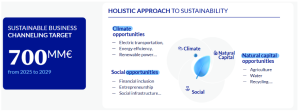
BBVA fosters the generation of new sustainable business through three growth levers described below:
1. Differentiated advice tailored to each segment
2. Development and financing of innovative solutions
3. Integrating sustainability into risk management
Sustainability governance
Within the framework of the Group’s overall management and control structure, the Board of Directors has approved the Strategic Plan for 2025-2029, which includes, as one of its six strategic priorities, “Boost sustainability as a growth engine”. In this regard, the Corporate Bodies are promoting the integration of Sustainability, encompassing ESG aspects, into all of the Group’s businesses and activities from a global perspective, and ensuring the appropriate management of the material impacts, risks, and opportunities arising from it.
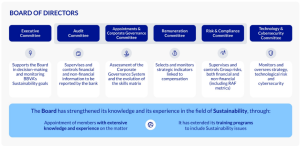
Integration of sustainability in the executive level across the Group
The implementation of the Sustainability strategy, approved by BBVA’s corporate bodies, requires cross-functional integration at the executive level. For this implementation, the Group has a Global Sustainability Area, whose head reports directly to both the Chairman, regarding transformation and sustainability strategy, and the CEO, regarding business matters.
Thus, the implementation of the Sustainability strategy is cross-cutting throughout the Group, with all its areas responsible for progressively incorporating it into their strategic agenda and work practices. To this end, the Global Sustainability Area is responsible, among other things, for designing and driving the implementation of the Group’s strategic Sustainability agenda (focusing on combating climate change, protecting natural capital, and inclusive growth) and developing business in this area; establishing the Group’s objectives in these matters; and promoting and coordinating the Group’s various lines of work in this area, developed by the different areas; while maintaining, across all areas of the Group, the objective of promoting integrity in relationships with different stakeholders.
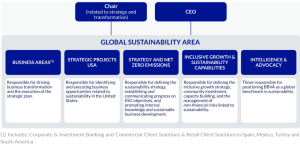
(1) Includes: Corporate & Investment Banking y Commercial Client Solutions & Retail Client Solutions in Spain, Mexico, Turkey and South America.
BBVA Group Transition Plan
BBVA Group Transition Plan
The Group has defined its Transition Plan, which acts as the global strategic framework for climate change management, establishing decarbonization targets for both the financed portfolio and its own operations.
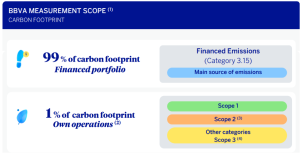 (1) For the year 2025, estimates are used for those data that are not available as of the closing date of the 2025 Consolidated Management Report.
(2) Electricity consumed is 100% renewable in Colombia, Spain, Mexico, Peru, Turkey, Portugal, Uruguay, and Argentina 90% in the Netherlands and Venezuela, 75% in Romania.
(3) Gross market-based scope 2 GHG emissions.
(4) Scope 3 includes: 3.1 (Purchased goods and services), 3.2 (Capital goods), 3.3 (Activities related to fuel and energy consumption not included in scope 1 or 2), 3.4 (Upstream transport and distribution), 3.5 (Waste generated in operations), 3.6 (Business travel), 3.7 (Employee commuting), 3.13 (Downstream leased assets).
The BBVA Group’s global strategy for managing its financed portfolio is structured around five main pillars:
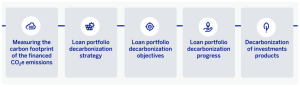
More information More information More information More information More information
Management of risks associated with climate change
Management of risks associated with climate change
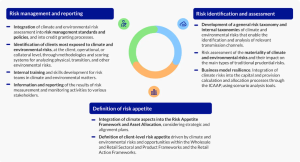
The management of climate and environmental risk factors is key to implement BBVA’s strategy, which is based on managing risks appropriately, supporting the transition to a low-carbon economy, and meeting the ambition of achieving net-zero carbon emissions by 2050.
Natural capital management
Natural capital management
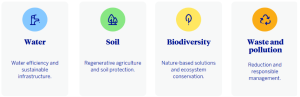
BBVA includes natural capital in its holistic vision of sustainability, which encompasses the geographies in which it operates. For BBVA, opportunities in natural capital are linked to investments that mitigate risks, improve efficiency, and protect natural resources in four key areas:
Natural capital, a source of essential ecosystem services, constitutes a functional foundation for economic stability and biosphere integrity. Aligned with ESRS¹ requirements and recognizing the financial sector’s structural dependency on nature, the Group integrates this management into its sustainability strategy as a growth engine that complements and reinforces climate action.
Through the application of the LEAP methodology (Locate, Evaluate, Assess, Prepare) and the use of specialized globally recognized analytical tools (such as ENCORE), the Group has mapped its exposure in sectors such as agriculture, water management, and the circular economy. This analysis, executed with a geographic and sectoral perspective, has enabled the assessment of the portfolio’s dependency on key ecosystem services.
This proactive management seeks to enhance the Group’s financial resilience against systemic and transition risks, while also identifying natural capital as a source of business opportunities.
¹ ESRS, European Sustainability Reporting Standards.
Management of other direct environmental impacts
Contribution to society
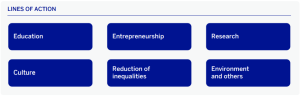
Beyond the positive impact generated by its banking activities—the main driver to contribute to the progress and development of the societies in which it operates—, BBVA complements this effect through robust social and philanthropic activity. This activity is channeled through social programs developed by the Group and its foundations, as well as through contributions to nonprofit organizations and the promotion of a corporate culture committed to social and environmental support, facilitating employee participation in volunteer initiatives.
Contribution through social programs and initiatives
BBVA established the 2025 Community Investment Goal, allocating €550 million to social initiatives to benefit 100 million people between 2021 and 2025. Both targets were met ahead of schedule, on December 31, 2024, with €590.2 million¹ allocated to social programs and nearly 106 million people reached.
¹ The 2024 data differ from those presented in the previous report, as the estimates included at the close of the 2024 financial year have been replaced by the actual data filed after the publication of that report.
Contributions to non-profit entities
Regarding contributions to foundations and non-profit entities, the total figure for 2025 was €22.3² million (€17.5 million in 2024).
² The figure for contributions to foundations and non-profit entities is estimated. 88% of the figure corresponds to contributions actually made before November 30, 2025, while 12% is an estimate of contributions expected to be made in December 2025.
Volunteer work
In total, more than 14,300 BBVA employees participated in volunteering initiatives during 2025 (around 13,500 in 2024), dedicating more than 94,000 hours (90% during work hours and 10% outside of work hours). The time dedicated by employees in 2025 is equivalent to a contribution of €1.1 million (around €1 million in 2024).
Double materiality analysis
Double materiality analysis
The double materiality analysis (hereinafter, DMA) assesses two key dimensions, considering the Group’s operating context. On the one hand, how the Group’s activities may affect society and the environment (impact materiality); and on the other, the risks and opportunities that the environment generates for the business (financial materiality).
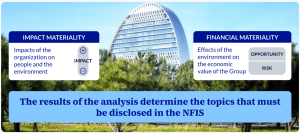
The DMA is conceived as a dynamic process subject to periodic reviews. Its evolution responds to updates in strategic priorities, market conditions, stakeholder dialogue and the regulatory environment, thus ensuring the continuous improvement of information quality.
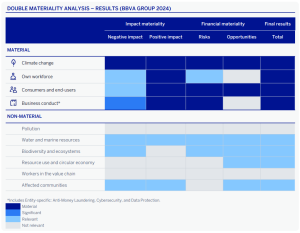
BBVA has identified material impacts, risks and opportunities within several sub-topics, which in turn correspond to four general topics:
- – Climate change
– Own workforce
– Consumers and end-users
– Business conduct*
* Includes entity-specific: Money laundering, Cybersecurity and Data protection.
Download PDF
More information regarding the methodology.
Sustainability as a growth engine
Sustainability is integrated into BBVA’s activity within a context of structural transformation driven by climate change and the need to advance towards more efficient and resilient economic models. This process incorporates considerations related to the protection of natural capital and the social sphere.
Accordingly, BBVA establishes “Sustainability as a growth engine” as a strategic priority, aiming to capture new business opportunities, strengthen the management of associated risks and advance the transition toward a carbon-neutral economy.
Sustainability as a growth engine
In its strategic plan for the period 2025-2029, BBVA has set a new objective of €700 billion for sustainable business channeling to support individuals, businesses, and corporations in their transformation.
BBVA fosters the generation of new sustainable business through three growth levers described below:
1. Differentiated advice tailored to each segment
2. Development and financing of innovative solutions
3. Integrating sustainability into risk management
Sustainability governance
Within the framework of the Group’s overall management and control structure, the Board of Directors has approved the Strategic Plan for 2025-2029, which includes, as one of its six strategic priorities, “Boost sustainability as a growth engine”. In this regard, the Corporate Bodies are promoting the integration of Sustainability, encompassing ESG aspects, into all of the Group’s businesses and activities from a global perspective, and ensuring the appropriate management of the material impacts, risks, and opportunities arising from it.
Integration of sustainability in the executive level across the Group
The implementation of the Sustainability strategy, approved by BBVA’s corporate bodies, requires cross-functional integration at the executive level. For this implementation, the Group has a Global Sustainability Area, whose head reports directly to both the Chairman, regarding transformation and sustainability strategy, and the CEO, regarding business matters.
Thus, the implementation of the Sustainability strategy is cross-cutting throughout the Group, with all its areas responsible for progressively incorporating it into their strategic agenda and work practices. To this end, the Global Sustainability Area is responsible, among other things, for designing and driving the implementation of the Group’s strategic Sustainability agenda (focusing on combating climate change, protecting natural capital, and inclusive growth) and developing business in this area; establishing the Group’s objectives in these matters; and promoting and coordinating the Group’s various lines of work in this area, developed by the different areas; while maintaining, across all areas of the Group, the objective of promoting integrity in relationships with different stakeholders.
(1) Includes: Corporate & Investment Banking y Commercial Client Solutions & Retail Client Solutions in Spain, Mexico, Turkey and South America.