


Macroeconomic environment
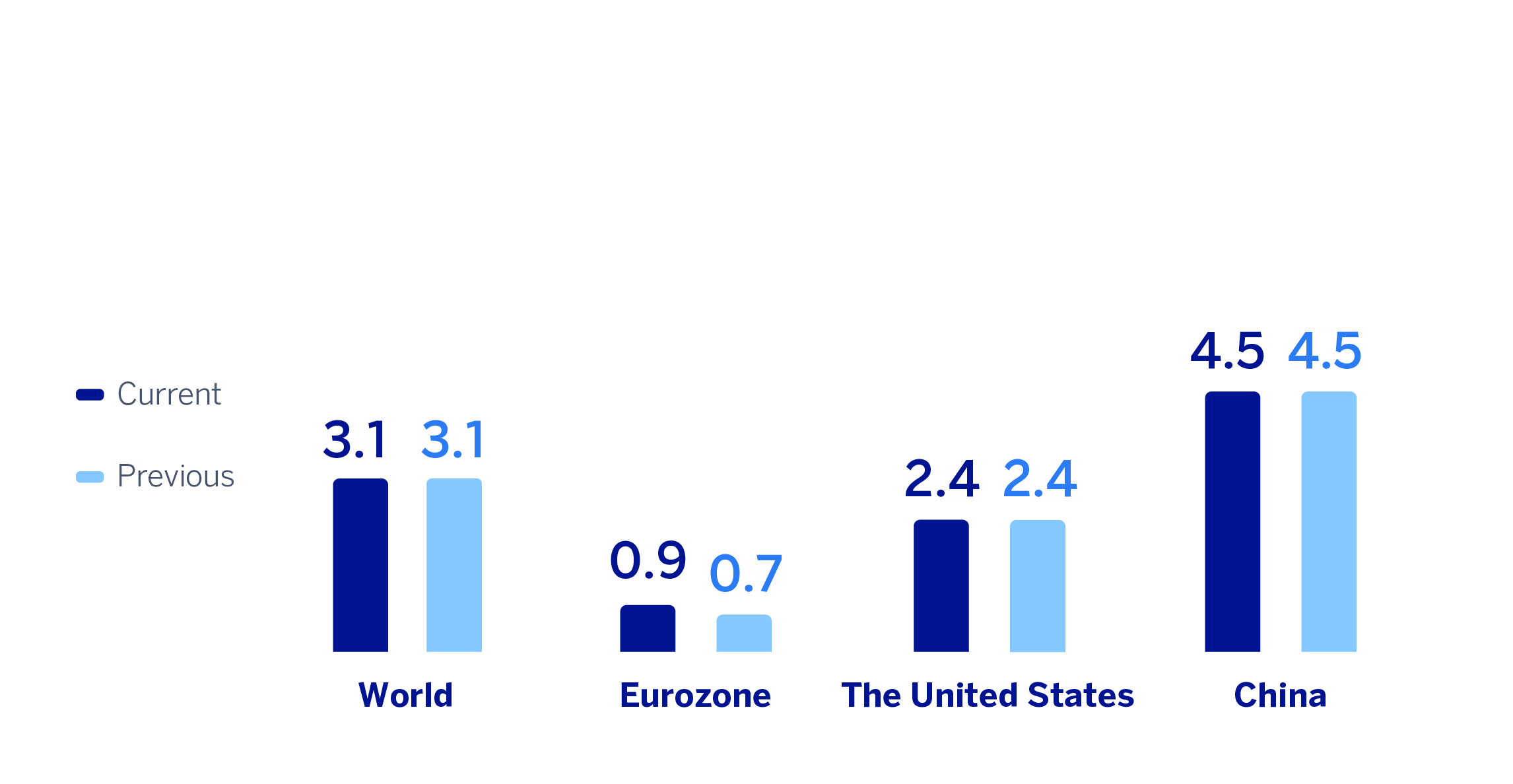
The global economy has maintained relatively solid growth during the third quarter of 2026, despite the persistence of geopolitical tensions, rising energy costs due to the prolongation of conflicts in the Middle East, and the increase in long-term sovereign yields. Investment linked to artificial intelligence, defense spending, and fiscal stimulus have continued to cushion the effect of these factors. BBVA Research leaves its global growth forecast for 2026 unchanged at 3.1%, and places it at 3.3% for 2027.
The relatively good performance of the US economy and the greater dynamism of the Eurozone explain the resilience of global growth in the third quarter. In particular, the expected GDP growth for the United States stands at 2.4% in 2026, the same forecast as in the previous scenario, and at 2.2% for the following year, supported by still solid domestic demand and investment in artificial intelligence. For the Eurozone, BBVA Research raises expected economic growth for 2026 by two-tenths of a percentage point, to 0.9%, and places it at 1.2% for 2027, to the extent that the increase in energy and financing costs is partially offset by a weaker euro. In China, the GDP growth forecast remains at 4.5% for 2026 and 4.2% for 2027, in a context of structural slowdown led by the adjustment in the real estate sector.
For its part, the resilience of demand and the maintenance of commodity prices at relatively high levels will limit the correction of inflation in the short term. In the United States, headline inflation could end 2026 slightly above 3%, leaving the annual average at around 3.3%. In the Eurozone inflation could exceed 3.5% by year-end (the annual average would be around 3%). In both economies, a progressive reduction in inflation is expected during 2027 toward average levels of 2.5%, under the assumption of a gradual moderation in energy prices. In this environment, the United States Federal Reserve and the European Central Bank have raised their reference rates. BBVA Research anticipates additional hikes before the end of 2026, up to 4.25% and 2.75%, respectively, and expects them to remain at these levels during 2027. In China, where inflation remains very contained, monetary conditions will continue to be accommodative, with reference rates at levels similar to those of 2025.
The balance of risks for the global economy remains tilted to the downside, given the uncertainty regarding the resolution of conflicts in the Middle East and Ukraine, the restoration of trade in the affected areas, and the performance of energy input prices. Added to this are doubts about the sustainability of public debt in several developed economies, tensions in sovereign debt yields, and the effects of protectionist measures in the areas of trade and immigration. The occurrence of extreme weather events, as well as a potential reactivation of the threat of interventionist actions by the US administration, also constitute sources of risk. Conversely, a faster normalization of energy markets and a greater impact of artificial intelligence on the productivity of the economies actively promoting its adoption are worth mentioning.
GDP GROWTH ESTIMATES IN 2026
(PERCENTAGE. YEAR-ON-YEAR VARIATION)
Source: BBVA Research estimates.
Read legal disclaimer of this report.