


Macroeconomic environment
The global economy has shown greater strength than expected during the last months of 2025 given the high levels of uncertainty, trade and geopolitical tensions, and the migration restrictions of the United States administration. The negative effects of protectionist policies and high geopolitical instability would have been mitigated by lower effective tariffs than initially announced, fiscal stimulus and the strong growth in investment in artificial intelligence, particularly in the United States. The expansionary nature of the monetary policy of the Federal Reserve (hereinafter, the Fed), the moderate inflation, and contained energy prices would have also supported global activity.
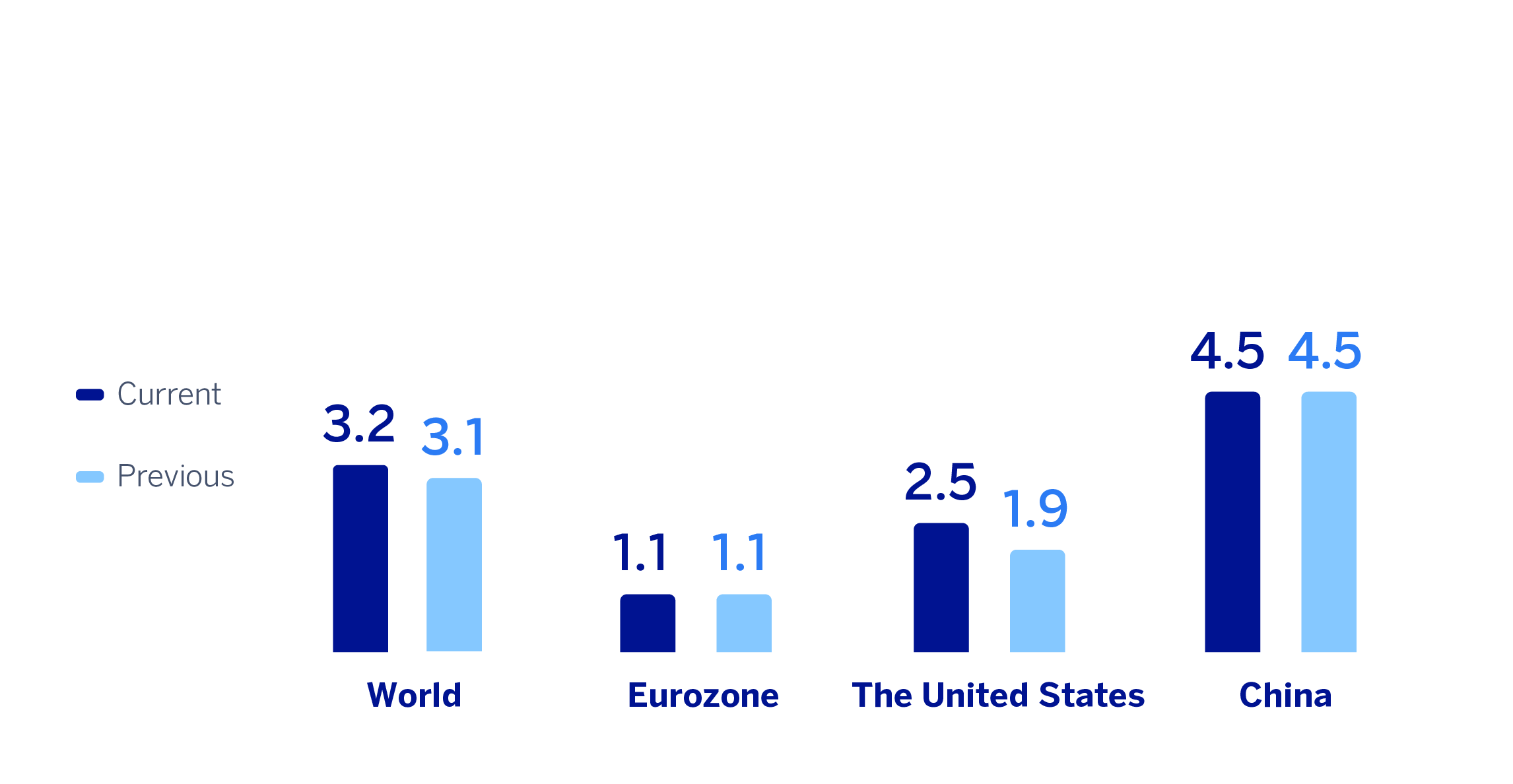
The conflict in Iran has once again raised uncertainty and geopolitical risk, and has significantly driven up oil and gas prices. Under the assumption that the conflict is resolved in a reasonable short period and tensions in the energy and financial markets progressively moderate, BBVA Research forecasts global growth to stand at 3.2% in 2026, the same figure as in 2025. This expectation of a certain resilience in global activity rests, in part, on the upward revision of the expected growth for the United States by six tenths to 2.5% (in 2025, growth was 2.1%) due to the strong increase in investment in artificial intelligence. In the case of the Eurozone, the forecast of a gradual deceleration in activity is maintained: compared to GDP growth of 1.5% in 2025, in 2026 it could be 1.1%, in a context where the impact of tariffs, political instability in some countries in the bloc, and the rise in energy prices could be partially offset by increased spending on defense and infrastructure. The growth expected for China also remains unchanged: GDP growth in 2026 could stand at 4.5%, compared to 5% in 2025.
It is foreseeable that the rise in tariffs, the strength of demand, and the recent tensions in fuel prices will keep inflation in the United States at around 3% for much of 2026, limiting the Fed's scope for interest rate cuts. Following the cuts in 2025, which brought the benchmark rate to 3.75%, BBVA Research forecasts two additional rate cuts to 3.25%, conditioned, in any case, on the duration of the conflict in Iran and its impact on prices. In the Eurozone, the ECB is expected to keep the deposit facility interest rate unchanged (at 2%) if inflationary pressures subside once the crisis in the Middle East is contained (the headline rate could remain above 2% throughout 2026). In China, monetary conditions are likely to continue to ease given the current context of very low inflation in which it finds itself.
The balance of risks for the global economy remains weighted to the downside, with growing uncertainty following the outbreak of the conflict between the United States, Israel, and Iran. In addition to protectionist measures in trade and immigration, and the structural challenges facing Europe and China, negative factors include increased geopolitical tensions (potential interventions of the United States in Latin America, the Middle East or Greenland) and uncertainty regarding the Fed's independence and its potential impact on financial markets. A sharp increase in the prices of oil, gas, and energy-intensive goods, derived from an escalation of tensions in the Middle East, emerges as a significant source of risk. On a positive note, however, it is worth mentioning the boost in investment in artificial intelligence and its medium-term effect on the productivity of economies that promote its adoption.
GDP GROWTH ESTIMATES IN 2026
(PERCENTAGE. YEAR-ON-YEAR VARIATION)
Source: BBVA Research estimates.
Read legal disclaimer of this report.