


Risk management
Credit risk
In a volatile global context, whose evolution will continue to be highly conditioned by the uncertainty represented by the United States administration's policies implemented in recent months, economic activity in the countries where BBVA operates continued to reflect a generally good dynamic in terms of economic growth, as well as in the indicators of the financial system. In Spain, the growth forecast for 2025 has been revised upwards (2.8%), and inflation could remain at moderate levels, with a comfortable level of solvency and liquidity in the system. In Mexico, a GDP forecast of around 1% is maintained for 2025, in a context of contained inflation, with expectations of additional interest rate cuts and with credit in the banking system currently growing at double digits (+14.0% year-on-year). Turkey, on the other hand, has shown significant growth in recent months, with inflation moderating and banking system risk indicators at contained levels, although pending political and social tensions that have generated volatility in the financial markets and some pressure on the local currency. Finally, in South America, the positive dynamics in terms of economic activity will continue, in a context of lower inflation and gradual interest rate cuts.
For the estimation of expected losses, the models include individual and collective estimates, taking into account the macroeconomic forecasts in accordance with IFRS 9. Thus, the estimate at the end of the quarter includes the effect on expected losses of updating macroeconomic forecasts, which take into account the global environment, although they may not fully reflect the most recent evolution of the economic environment, especially in contexts of high uncertainty and volatility or very recent events that are still developing. Additionally, the Group may complement the expected losses either by considering additional risk drivers, or by incorporating sectorial particularities or those that may affect a set of operations or borrowers, following a formal internal process established for the purpose.
BBVA Group's credit risk indicators
The evolution of the Group’s main credit risk indicators is summarized below:
- Credit risk increased by 1.3% in the first quarter of the year (+3.5% at constant exchange rates), with generalized growth in all geographical areas, and highlighting, in percentage terms and at constant exchange rates, the variation of Turkey, Rest of Business and Spain. During the last twelve months, this growth stood at 7.0% (+12.8% at constant exchange rates), with double-digit growth in most geographical areas at constant exchange rates with origin mainly in Turkey, Rest of Business, Spain and Mexico.
- The balance of non-performing loans declined 3.7% in the first quarter of 2025 at Group level. At constant exchange rates the variation stood at -2.1%, mainly as a result of the reduction in the balance of non-performing loans in Spain, Mexico and, to a lesser extent, South America. In general, this decline was supported by a higher volume of write-offs and contained net entries. During the last twelve months, the reduction in non-performing balances in constant terms stood at -4.7% (-9.0% at current exchange rates), with declines in Spain, Rest of Business and South America, which mitigated increases in the rest of geographical areas.
NON-PERFORMING LOANS AND PROVISIONS (MILLIONS OF EUROS)
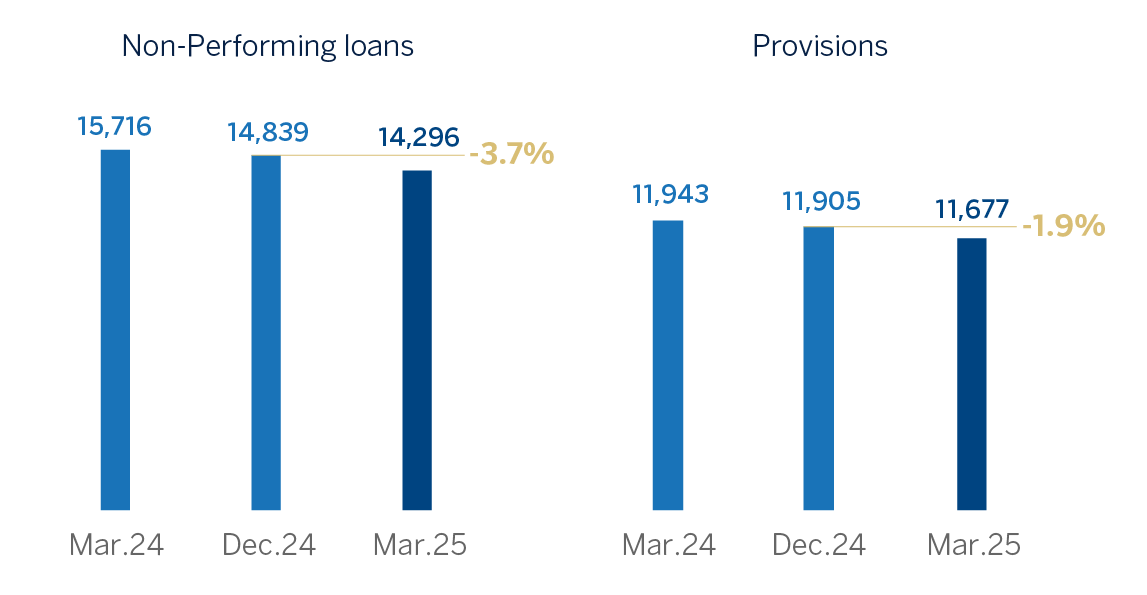
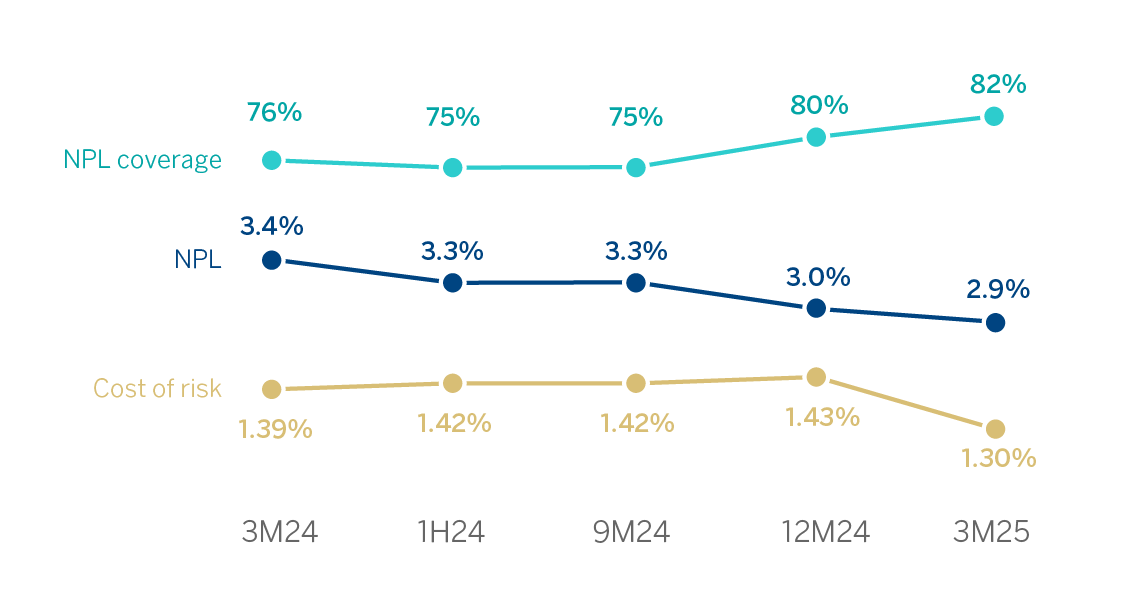
- The NPL ratio stood at 2.9% in March 31, 2025, 15 basis points lower than the previous quarter, with generalized decreases during the quarter in all geographical areas except for Turkey and with an improvement of 51 basis points compared to the end of March 2024. This decline has been possible in a context of lower non-performing loans and strong credit growth.
- The NPL coverage ratio ended the quarter at 82%, which represents an increase of 145 basis points compared to the previous quarter, and of 569 basis points compared to the end of March 2024, with generalized increases in the quarter in all geographical areas, except for Turkey supported by the reduction in non-performing loans.
- The cumulative cost of risk as of March 31, 2025 stood at 1.30%, 12 basis points below the previous quarter and with an improvement of 8 basis points compared to the end of March 2024. All business areas show an improvement on this indicator, except for Turkey, in line with the expectations.
NPL AND NPL COVERAGE RATIOS AND COST OF RISK (PERCENTAGE)
| CREDIT RISK (1) (MILLIONS OF EUROS) | |||||
|---|---|---|---|---|---|
| 31-03-25 | 31-12-24 | 30-09-24 | 30-06-24 | 31-03-24 | |
| Credit risk | 494,729 | 488,302 | 461,408 | 469,687 | 462,457 |
| Stage 1 | 447,804 | 439,209 | 407,658 | 414,956 | 405,765 |
Stage 2 (2)| 32,629 | 34,254 | 38,423 | 39,298 | 40,975 |
|
| Stage 3 (non-performing loans) | 14,296 | 14,839 | 15,327 | 15,434 | 15,716 |
| Provisions | 11,677 | 11,905 | 11,457 | 11,560 | 11,943 |
| Stage 1 | 2,409 | 2,434 | 2,083 | 2,162 | 2,198 |
| Stage 2 | 1,942 | 1,902 | 1,824 | 1,911 | 2,130 |
| Stage 3 (non-performing loans) | 7,326 | 7,569 | 7,550 | 7,486 | 7,615 |
| NPL ratio (%) | 2.9 | 3.0 | 3.3 | 3.3 | 3.4 |
NPL coverage ratio (%) (3)| 82 | 80 | 75 | 75 | 76 |
|
(1) Includes gross loans and advances to customers plus guarantees given.
(2) During 2024, the criteria for identifying significant increases in credit risk were reviewed and updated. As part of this update, certain short-term portfolio transactions, as well as those meeting the expanded definition of the low credit risk exception, were excluded from transfer based on certain quantitative criteria. These changes resulted to a significant reduction in the Stage 2 balance at the Group level during the last quarter of 2024, with the impact of these measures primarily concentrated in BBVA, S.A.
(3) The NPL coverage ratio includes the valuation adjustments for credit risk throughout the expected residual life in those financial instruments that have been acquired (mainly originating from the acquisition of Catalunya Banc, S.A.). If these valuation corrections had not been taken into account, the NPL coverage ratio would have stood at 81% as of March 31, 2025.
| NON-PERFORMING LOANS EVOLUTION (MILLIONS OF EUROS) | |||||
|---|---|---|---|---|---|
| 1Q25 (1) | 4Q24 | 3Q24 | 2Q24 | 1Q24 | |
| Beginning balance | 14,839 | 15,327 | 15,434 | 15,716 | 15,305 |
| Entries | 2,861 | 3,107 | 3,036 | 2,927 | 3,184 |
| Recoveries | (1,741) | (2,582) | (1,730) | (1,500) | (1,530) |
| Net variation | 1,119 | 525 | 1,307 | 1,427 | 1,655 |
| Write-offs | (1,330) | (1,178) | (953) | (1,212) | (1,216) |
| Exchange rate differences and other | (333) | 165 | (460) | (498) | (27) |
| Period-end balance | 14,296 | 14,839 | 15,327 | 15,434 | 15,716 |
| Memorandum item: | |||||
| Non-performing loans | 13,771 | 14,211 | 14,590 | 14,672 | 14,938 |
| Non performing guarantees given | 526 | 628 | 737 | 761 | 778 |
(1) Preliminary data.
Structural risks
Liquidity and funding
Liquidity and funding management at BBVA is aimed at driving the sustained growth of the banking business, through access to a wide variety of alternative sources of funding and assuring optimal term and cost conditions. BBVA's business model, risk appetite framework and funding strategy are designed to reach a solid funding structure based on stable customer deposits, mainly retail (granular). As a result of this model, deposits have a high degree of insurance in each geographical area being close to 55% in Spain and Mexico. It is important to note that, given the nature of BBVA's business, lending is mainly financed through stable customer funds.
One of the key elements in the BBVA Group's liquidity and funding management is the maintenance of large high-quality liquidity buffers in all geographical areas. Thus, the Group has maintained during the last 12 months an average volume of high-quality liquid assets (HQLA) of €127.2 billion, of which 98% corresponded to maximum quality assets (level 1 in the liquidity coverage ratio, LCR).
Due to its subsidiary-based management model, BBVA is one of the few major European banks that follows the Multiple Point of Entry (MPE) resolution strategy: the parent company sets the liquidity policies, but the subsidiaries are self-sufficient and responsible for managing their own liquidity and funding (taking deposits or accessing the market with their own rating). This strategy limits the spread of a liquidity crisis among the Group's different areas and ensures the adequate transmission of the cost of liquidity and financing to the price formation process.
The BBVA Group maintains a solid liquidity position in every geographical area in which it operates, with ratios well above the minimum required:
- The LCR requires banks to maintain a volume of high-quality liquid assets sufficient to withstand liquidity stress for 30 days. BBVA Group's consolidated LCR remained comfortably above 100% during the first three months of 2025 and stood at 138% as of March 31, 2025. It should be noted that, given the MPE nature of BBVA, this ratio limits the numerator of the LCR for subsidiaries of BBVA S.A. to 100% of their net outflows, therefore, the resulting ratio is below that of the individual units (the LCR of the main components was 168% in BBVA, S.A., 162% in Mexico and 131% in Turkey). Without considering this restriction, the Group's LCR ratio was 165%.
- The net stable funding ratio (NSFR) requires banks to maintain a stable funding profile in relation to the composition of their assets and off-balance sheet activities. The BBVA Group's NSFR ratio stood at 127% as of March 31, 2025.
The breakdown of these ratios in the main geographical areas in which the Group operates is shown below:
| LCR AND NSFR RATIOS (PERCENTAGE. 31-03-25) | ||||
|---|---|---|---|---|
| BBVA, S.A. | Mexico | Turkey | South America | |
| LCR | 168% | 162% | 131% | All countries >100 |
| NSFR | 119% | 132% | 157% | All countries >100 |
In addition to the above, the most relevant aspects related to the main geographical areas are the following:
- BBVA, S.A. has maintained a strong position with a large high-quality liquidity buffer, maintaining at all times the regulatory liquidity metrics well above the set minimums. During the first quarter of 2025, commercial activity showed dynamism with growth both in deposits and especially in lending.
- BBVA Mexico shows a solid liquidity situation, even though the credit gap has reduced during the first three months of 2025 as a result of the strong dynamism of lending accompanied by an even greater growth in deposit collection.
- In Turkey, Garanti BBVA shows a strong liquidity generation in the first quarter of 2025. Thus, the lending gap has reduced both in local and foreign currencies due to a strong increase in deposits exceeding the increase in loans. Last month also saw an increase in foreign currency demand (US dollars).
- In South America, the liquidity situation remains adequate throughout the region in the first quarter of 2025. In BBVA Argentina, the credit gap improved in Argentine pesos despite strong loan growth due to the boost in wholesale time deposits. In the US dollar balance sheet, the boost in loan growth combined with the reduction in deposits led to a reduction in excess liquidity in this currency. In BBVA Colombia, the credit gap widened during the quarter, with growth in the loan portfolio above the volume of deposits. In BBVA Peru, the credit gap increased as a result of deposit outflows; however, the liquidity situation remains solid.
The main wholesale financing transactions carried out by the BBVA Group during the first quarter of 2025 are listed below:
| Issuer | Type of issue | Date of issue | Nominal (millions) | Currency | Coupon | Early redemption | Maturity date |
| BBVA, S.A. | AT1 | Jan-25 | 1,000 | USD | 7.750% | Jan-32 | Perpetual |
| Tier 2 | Feb-25 | 1,000 | EUR | 4.000% | Feb-32 | Feb-37 |
Also, on April 1, 2025, BBVA announced its irrevocable decision to redeem early, and entirely, an issue of simple preferred bonds made in May 2023 for €1 billion on May 10, 2025.
BBVA Mexico issued in February 2025 USD 1 billion of Tier 2 subordinated debt with a coupon of 7.625%, and maturity in February 2035 (with an early redemption date in February 2030). In March, an issue was made in the local market for 15 billion Mexican pesos, in two tranches, the first, BBVAMX 25, was placed for a term of three and a half years with a variable rate of TIIE overnight funding plus 32 basis points, while the second tranche, BBVAMX 25-2, closed at a fixed rate of 9.67% for a term of seven years.
In the first quarter, Garanti BBVA issued a total of USD 736m of short-term Senior MtNs (Medium term notes) in order to roll over maturities and generate liquidity.
In February 2025, BBVA Argentina issued a total of €91m in four senior issues, issued 66 billion Argentine pesos (9 billion at 7 months with fixed rates and 57 billion at 12 months with variable rates) and USD 37m (16.5m at 12 months and 20.5m at 6 months).
In December 2024, BBVA Peru signed a contract with the Inter-American Development Bank (hereinafter IDB) and the Development Finance Corporation (COFIDE, for its acronym in Spanish) for the first tranche of a USD 100m social bond with a 5-year term and a SOFR+1.35% rate, which has already been paid out.
Foreign exchange
Foreign exchange risk management aims to reduce both the sensitivity of the capital ratios to currency movements, as well as the variability of profit attributed to currency movements.
The performance of the Group's main currencies was mixed during the first quarter of 2025. Due to its relevance for the Group, it is important to highlight the performance of the Mexican peso, which depreciated moderately by 2.3% against the euro in the quarter. In the case of the US dollar, it depreciated by 3.9% in the quarter due to the tariff measures, which have generated trade tensions with the country; however, it shows stability with respect to the same period of 2024. On the other hand, the Turkish lira suffered the most notable depreciation (10.5%). Likewise, the Peruvian sol and the Argentine peso depreciated against the euro (1.3% and 7.6%, respectively), while the Chilean and Colombian peso appreciated by 1.2% and 1.0%, respectively, against the euro.
| EXCHANGE RATES | ||||||
|---|---|---|---|---|---|---|
| Currency/Euro | ∆ % of the currency against | ∆ % of the currency against | Currency/Euro | ∆ % of the currency against |
||
| 31-03-25 | 31-03-24 | 31-12-24 | 1Q25 | 1Q24 | ||
| U.S. dollar | 1.0815 | — | (3.9) | 1.0523 | 3.2 | |
| Mexican peso | 22.0627 | (18.8) | (2.3) | 21.4988 | (14.2) | |
| Turkish lira (1) | 41.0399 | (14.8) | (10.5) | — | — | |
| Peruvian sol | 3.9550 | 1.5 | (1.3) | 3.8905 | 4.8 | |
| Argentine peso (1) | 1,160.86 | (20.1) | (7.6) | — | — | |
| Chilean peso | 1,023.21 | 3.7 | 1.2 | 1,013.92 | 1.3 | |
| Colombian peso | 4,534.26 | (8.4) | 1.0 | 4,411.00 | (3.6) | |
(1) According to IAS 21 "The effects of changes in foreign exchange rates", the year-end exchange rate is used for the conversion of the Turkey and Argentina income statement.
In relation to the hedging of the capital ratios, BBVA aims to cover in aggregate, 70% of its subsidiaries' capital excess. The sensitivity of the Group's CET1 fully loaded ratio to 10% depreciations in major currencies is estimated at: +17 basis points for the US dollar, -9 basis points for the Mexican peso and -4 basis points for the Turkish lira15. With regard to the hedging of results, BBVA hedges between 40% and 50% of the aggregate net attributable profit it expects to generate in the next 12 months. For each currency, the final amount hedged depends, among other factors, on its expected future evolution, the costs and the relevance of the incomes related to the Group's results as a whole.
Interest rate
Interest rate risk management seeks to limit the impact that BBVA may suffer, both in terms of net interest income (short-term) and economic value (long-term), from adverse movements in the interest rate curves in the various currencies in which the Group operates. BBVA carries out this work through an internal procedure, pursuant to the guidelines established by the European Banking Authority (EBA), with the aim of analyzing the potential impact that could derive from a range of scenarios on the Group's different balance sheets.
The model is based on assumptions intended to realistically mimic the behavior of the balance sheet. The assumptions regarding the behavior of accounts with no explicit maturity and prepayment estimates are specially relevant. These assumptions are reviewed and adapted, at least, once a year according to the evolution in observed behaviors.
At the aggregate level, BBVA continues to maintain a limited risk profile in line with the target set in the environment of the change of cycle to lower interest rates, with positive sensitivity to interest rate rises in net interest income.
In the first quarter of 2025, the US and European yield curves diverged. While the sovereign curve fell in the United States due to the deceleration rumors, in Europe a rebound was observed, due to the change of course in Germany's fiscal policy, which was transferred to the peripheral curves of Spain and Italy. In Turkey, yield curves were more volatile as a result of the political situation. Meanwhile, in Mexico, the sovereign curve fell, (due to the United States) and in South America there were generalized growth profitability in Colombia and Argentina, with higher stability in Peru. All in all, the Group's fixed-income portfolios had a heterogeneous performance during the quarter, with an improved valuations in Mexico, relative stability in Spain and deterioration in Turkey and South America.
By geographical areas:
-
Spain has a balance sheet characterized by a lending portfolio with a high proportion of variable-rate loans (mortgages and corporate lending) and liabilities composed mainly by customer demand deposits. The ALCO portfolio acts as a management lever and hedge for the balance sheet, mitigating its sensitivity to interest rate fluctuations. The exposure of the net interest income to movements in interest rates remains limited.
The European Central Bank continued to carry out interest rate cuts due to the convergence of the inflation towards the target. Thus, the benchmark interest rate in the euro area stood at 2.65% at the end of March 2025, the rate on the deposit facility at 2.50% and the rate on the marginal lending facility at 2.90%. On April 17, 2025, the ECB carried out an additional 25 basis points cut in official policy rates. - Mexico continues to show a balance between fixed and variable interest rates balances, which results in a limited sensitivity to interest rates fluctuations. Among the assets that are most sensitive to interest rate changes, the commercial portfolio stood out, while consumer and mortgage portfolios are mostly at a fixed rate. With regard to customer funds, the high proportion of non-interest bearing deposits, which are insensitive to interest rate movements, should be highlighted. The ALCO portfolio is invested primarily in fixed-rate sovereign bonds with limited durations. The monetary policy rate stood at 9.0% at the end of March 2025, 100 basis points below the end of 2024.
- In Turkey, the sensitivity of net interest income to rates remains limited in both local and foreign currencies, thanks to the bank's management, with a low loan-to-deposit repricing gap. At the end of March 2025, the Central Bank of the Republic of Turkey (CBRT) set the monetary policy rate at 42.5% (500 basis points below its level at the end of December 2024). However, in response to the political instability and its impact on the markets, in March it reduced liquidity in the system, raising the cost of funding towards the high end of the rate corridor (46.0%). Subsequent to the end of the quarter, the CBRT raised the monetary policy rate to 46%.
- In South America, the sensitivity of net interest income continues to be limited, since most of the countries in the area have a fixed/variable composition stable between assets and liabilities. In addition, in balance sheets with several currencies, the interest rate risk is managed for each of the currencies, showing a very low level of exposure. Regarding benchmark interest rates, in Peru it stood at 4.75% as of March 2025, 25 basis points below its December 2024 closing level and have maintained unchanged in the central bank's April meeting. In Colombia, the central bank has maintained the benchmark interest rate at 9.50%, unchanged from the 2024 end. In Argentina, the central bank maintained the benchmark interest rate at 29%, which is a decrease of 300 basis points compared to the end of December 2024.
| INTEREST RATES (PERCENTAGE) | |||||
|---|---|---|---|---|---|
| 31-03-25 | 31-12-24 | 30-09-24 | 30-06-24 | 31-03-24 | |
| Official ECB rate | 2.65 | 3.15 | 3.65 | 4.25 | 4.50 |
| Euribor 3 months (1) | 2.44 | 2.83 | 3.43 | 3.73 | 3.92 |
| Euribor 1 year (1) | 2.40 | 2.44 | 2.94 | 3.65 | 3.72 |
| USA Federal rates | 4.50 | 4.50 | 5.00 | 5.50 | 5.50 |
| TIIE (Mexico) | 9.00 | 10.00 | 10.50 | 11.00 | 11.00 |
| CBRT (Turkey) | 42.50 | 47.50 | 50.00 | 50.00 | 50.00 |
(1) Calculated as the month average.
15 This sensitivity does not include the cost of capital hedges, which are currently estimated at 2 basis points per quarter for Mexican peso and 2 basis points per quarter for Turkish lira.