


Turkey
Highlights
- Increase in lending activity and customer funds
- Growth in net interest income supported by activity growth
- Lower year-on-year impact from hyperinflation
- Favorable evolution of the attributable profit
BUSINESS ACTIVITY (1)
(VARIATION AT CONSTANT EXCHANGE RATE COMPARED TO 31-12-24)
(1) Excluding repos.
NET INTEREST INCOME / AVERAGE TOTAL ASSETS
(PERCENTAGE AT CONSTANT EXCHANGE RATE)
OPERATING INCOME
(MILLIONS OF EUROS AT CURRENT EXCHANGE RATE)
NET ATTRIBUTABLE PROFIT (LOSS)
(MILLIONS OF EUROS AT CURRENT EXCHANGE RATE)
| FINANCIAL STATEMENTS AND RELEVANT BUSINESS INDICATORS (MILLIONS OF EUROS AND PERCENTAGE) | ||||
|---|---|---|---|---|
| Income statement | 1H25 | 𝝙 % | 𝝙 % (1) | 1H24 |
| Net interest income | 1,307 | 116.0 | 174.7 | 605 |
| Net fees and commissions | 1,058 | 16.9 | 51.4 | 905 |
| Net trading income | 221 | (63.2) | (52.4) | 601 |
| Other operating income and expenses | (177) | (19.4) | (56.2) | (219) |
| Gross income | 2,409 | 27.3 | 94.9 | 1,892 |
| Operating expenses | (1,080) | 18.8 | 50.6 | (909) |
| Personnel expenses | (616) | 17.1 | 50.8 | (526) |
| Other administrative expenses | (350) | 23.0 | 57.9 | (284) |
| Depreciation | (114) | 15.9 | 30.7 | (99) |
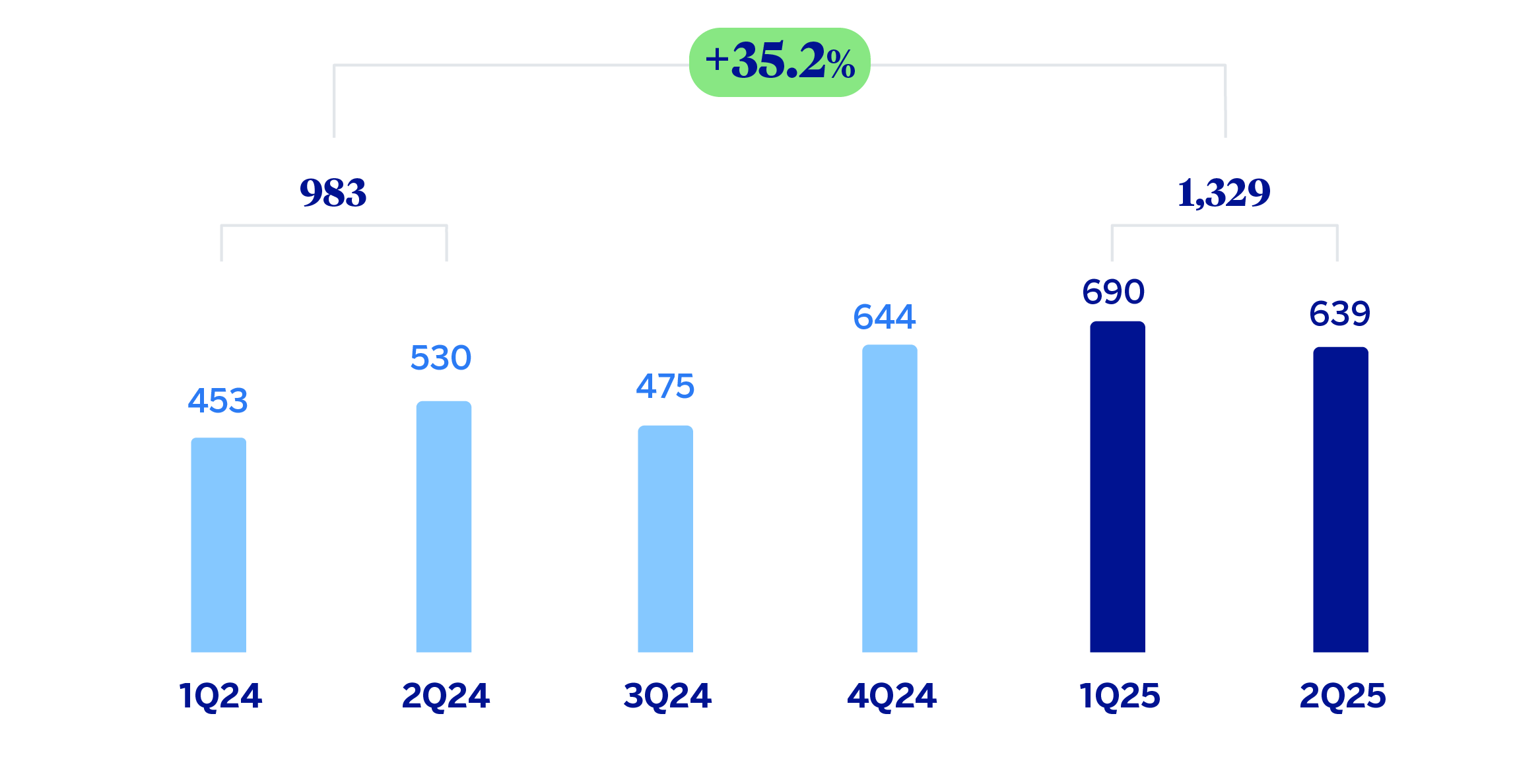
| Operating income | 1,329 | 35.2 | 156.2 | 983 |
| Impairment on financial assets not measured at fair value through profit or loss | (407) | 168.7 | 246.6 | (152) |
| Provisions or reversal of provisions and other results | 11 | (87.2) | (86.1) | 82 |
| Profit (loss) before tax | 932 | 2.0 | 95.5 | 914 |
| Income tax | (442) | (11.2) | 16.0 | (498) |
| Profit (loss) for the period | 490 | 17.9 | n.s. | 416 |
| Non-controlling interests | (78) | 20.9 | n.s. | (64) |
| Net attributable profit (loss) | 412 | 17.3 | n.s. | 351 |
| Balance sheets | 30-06-25 | 𝝙 % | 𝝙 % (1) | 31-12-24 |
| Cash, cash balances at central banks and other demand deposits | 9,501 | 7.6 | 36.4 | 8,828 |
| Financial assets designated at fair value | 4,560 | 1.3 | 28.4 | 4,503 |
| Of which: Loans and advances | 6 | 292.3 | n.s. | 2 |
| Financial assets at amortized cost | 64,147 | (1.1) | 25.3 | 64,893 |
| Of which: Loans and advances to customers | 48,046 | (0.5) | 26.1 | 48,299 |
| Tangible assets | 1,808 | (12.4) | 1.8 | 2,064 |
| Other assets | 2,466 | (1.1) | 23.9 | 2,494 |
| Total assets/liabilities and equity | 82,482 | (0.4) | 26.0 | 82,782 |
| Financial liabilities held for trading and designated at fair value through profit or loss | 1,719 | (11.6) | 12.1 | 1,943 |
| Deposits from central banks and credit institutions | 4,485 | 5.1 | 33.2 | 4,267 |
| Deposits from customers | 58,250 | 0.3 | 27.1 | 58,095 |
| Debt certificates | 5,152 | 14.1 | 44.6 | 4,517 |
| Other liabilities | 4,139 | (27.6) | (11.4) | 5,714 |
| Regulatory capital allocated | 8,737 | 6.0 | 34.1 | 8,245 |
| Relevant business indicators | 30-06-25 | 𝝙 % | 𝝙 % (1) | 31-12-24 |
| Performing loans and advances to customers under management (2) | 47,726 | (1.1) | 25.4 | 48,242 |
| Non-performing loans | 2,212 | 9.7 | 39.1 | 2,016 |
| Customer deposits under management (2) | 57,121 | (0.6) | 26.1 | 57,443 |
| Off-balance sheet funds (3) | 20,323 | 12.4 | 42.5 | 18,076 |
| Risk-weighted assets | 66,645 | 2.8 | 30.0 | 64,821 |
| RORWA (4) | 1.60 | 1.20 | ||
| Efficiency ratio (%) | 44.8 | 50.1 | ||
| NPL ratio (%) | 3.4 | 3.1 | ||
| NPL coverage ratio (%) | 86 | 96 | ||
| Cost of risk (%) | 1.64 | 1.27 | ||
| (1) At constant exchange rate. (2) Excluding repos. (3) Includes mutual funds and pension funds. (4) For more information on the calculation methodology, as well as the calculation of the metric at the consolidated Group level, see Alternative Performance Measures at this report. |
||||
Macro and industry trends
Growth has moderated recently, which together with the restrictive monetary policy tone has contributed to a further reduction in inflation, to 35% in June. BBVA Research maintains its growth forecast of 3.5% in 2025 unchanged (after a growth of 3.2% in 2024), and estimates that inflation will continue to moderate to around 30% in December. Monetary conditions, which tightened in the second quarter of the year to counter financial volatility stemming from the recent sociopolitical tensions, could ease again in the coming months, allowing interest rates to fall from 46% in June to around 36% in December.
The Turkish banking system continues to be affected by the impact of inflation. The total volume of credit in the system increased by 39.1% year-on-year at the end of May 2025, similar to the previous months. The stock of credit continues to be driven by consumer credit and credit card portfolios (+44.5% year-on-year) and by corporate credit (+37.7% year-on-year). Total deposits maintained the strength of recent months and grew 38.5% year-on-year at the end of May 2025, with similar growth in Turkish lira and dollar deposits (+39.5% and +36.8% respectively). Dollarization of the system decreased to 37.0% in May this year, from 37.5% a year earlier. The system's NPL ratio remains well under control and stood at 2.28% in May 2025. The capital indicators remained comfortable at the same date.
Unless expressly stated otherwise, all comments below on rates of changes for both activity and results, will be presented at constant exchange rates. These rates, together with changes at current exchange rates, can be observed in the attached tables of the financial statements and relevant business indicators. For the conversion of these figures, the end of period exchange rate as of June 30, 2025 is used, reflecting the considerable depreciation by the Turkish lira in the last twelve months. Likewise, the Balance sheet, the Risk-Weighted Asset (RWA) and the equity are affected.
Activity15
The most relevant aspects related to the area's activity during the first half of 2025 were:
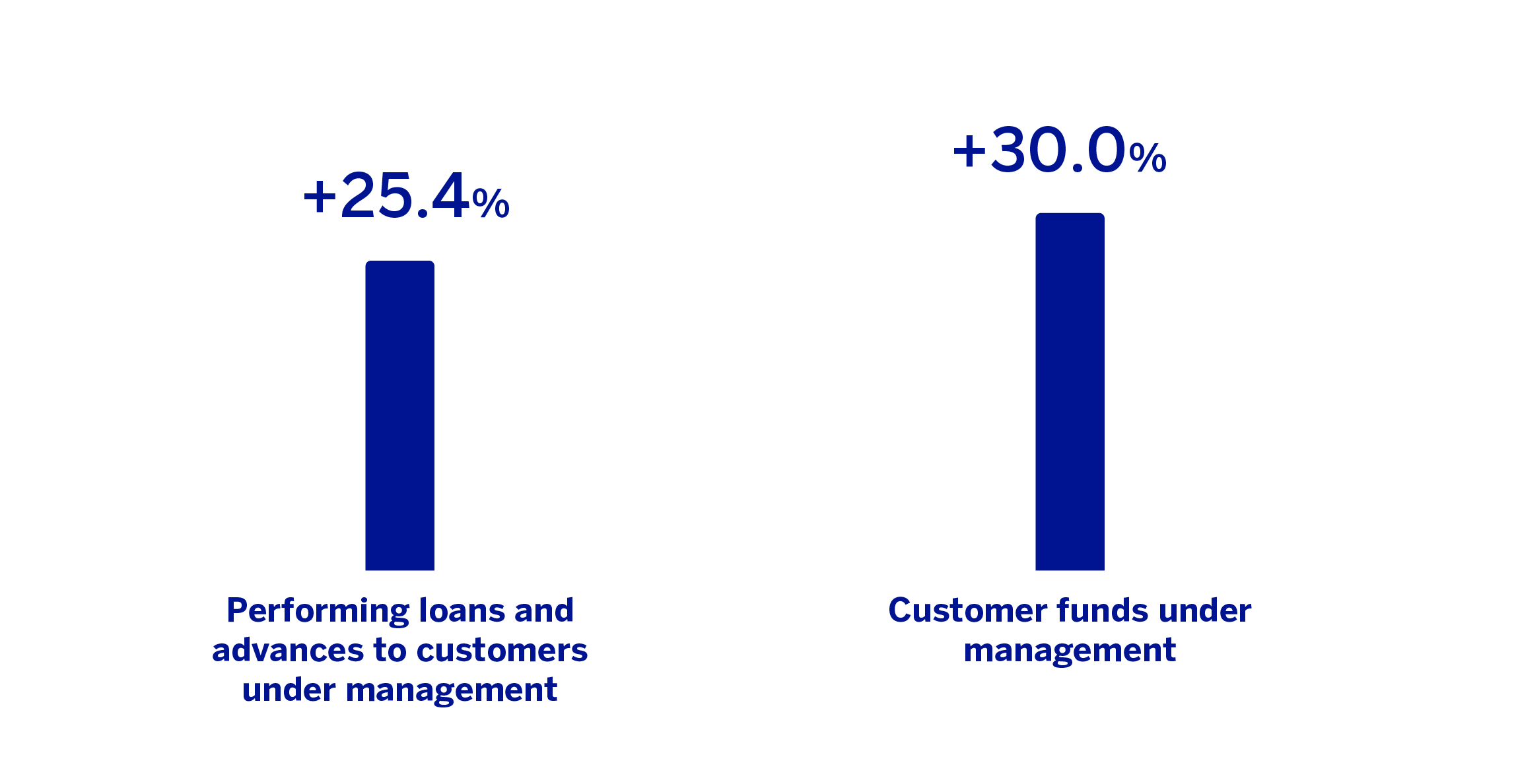
Lending activity (performing loans under management) recorded an increase of 25.4% between January and June 2025, mainly driven by the growth in Turkish lira loans (+17.7%). This growth was largely supported by the performance of credit cards and consumer loans. Foreign currency loans (in US dollars) increased by 11.8%, boosted by the increase in activity with customers focused on foreign trade (with natural hedging of exchange rate risk).
Customer deposits (70.6% of the area's total liabilities as of June 30, 2025) remained the main source of funding for the balance sheet and increased by 26.1% favored by evolution the positive performance of Turkish lira time deposits (+23.4%), which represent a 82.8% of total customer deposits in local currency. Balances deposited in foreign currency (in U.S. dollars) increased by 14.1%. Thus, as of June 30, 2025, Turkish lira deposits accounted for 66% of total customer deposits in the area. For its part, off-balance sheet funds grew by 42.5%.
The most relevant aspects related to the area’s activity in the second quarter of 2025 were:
Lending activity (performing loans under management) increased by 13.5%, mainly driven by the growth in Turkish lira loans (+10.6%, above the quarterly inflation rate, which stood at 6.0%). Within Turkish lira loans, credit cards and consumer loans continue to drive the growth, which grew at rates of 13.3% and 9.2%, respectively. Growth in foreign currency loans stood at 6.0%, favored by commercial loans.
In terms of asset quality, the NPL ratio increased by 23 basis points compared to the figure as of the end of March to 3.4%, mainly as a result of the increase in non-performing loans, both in the retail and the wholesale portfolios, partially offset by sales of impaired loans. On the other hand, the NPL coverage ratio recorded a decrease of 699 basis points in the quarter due to the release of certain customers and new additions to NPLs, to 86% as of June 30, 2025.
Customer deposits increased by 4.0%, with growth in Turkish lira balances (+3.7%, driven by term deposits), and reduction in US dollar deposits (-5.7%). Additionally, off-balance sheet funds grew 24.2% in the quarter.
Results
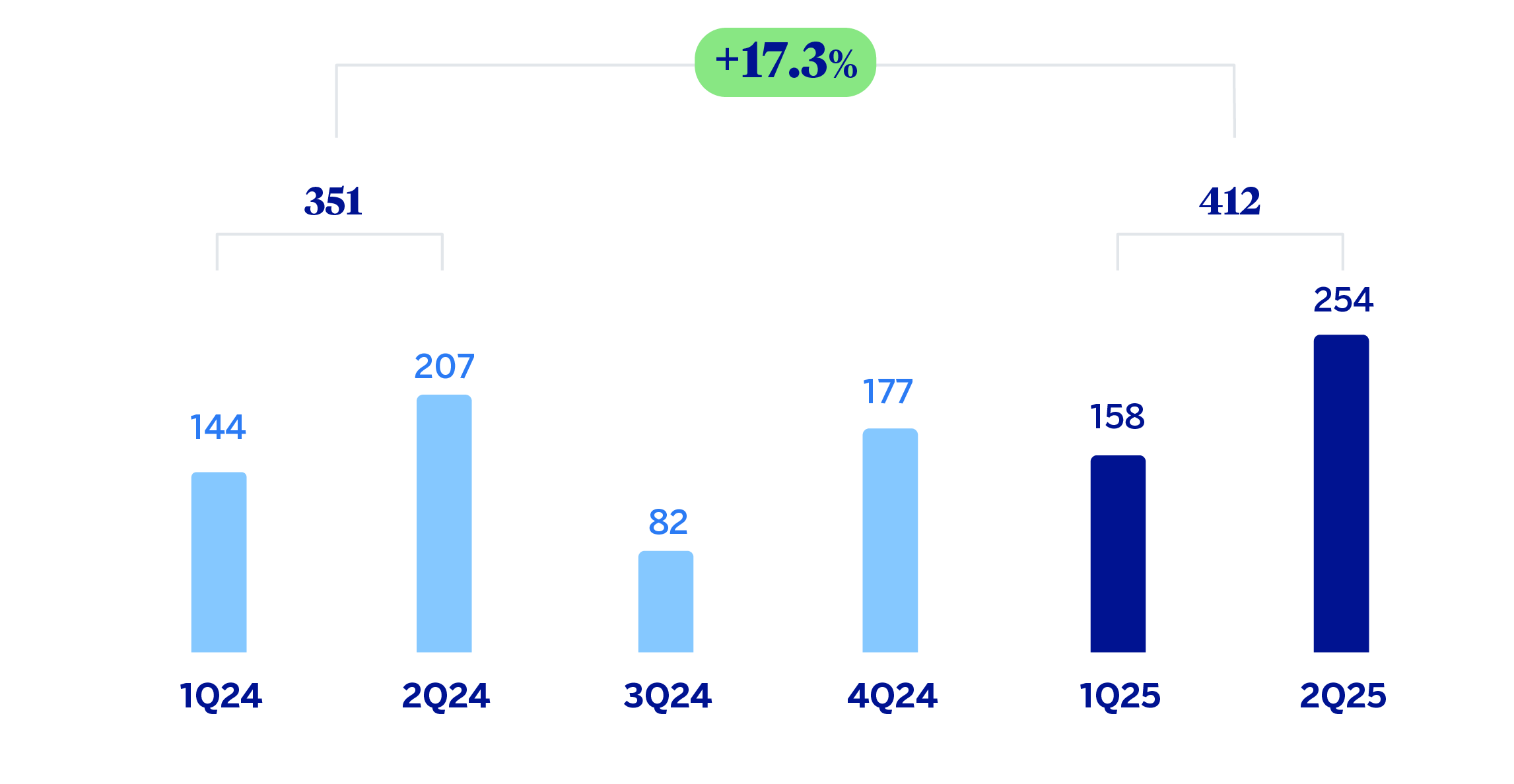
Turkey generated a net attributable profit of €412m during the first half of 2025, which compares very favorably with the result achieved in the first half of the previous year, as a result of the good performance of recurring revenues in banking business (net interest income and net fees and commissions) and a less negative hyperinflation impact.
As mentioned above, the year-on-year comparison of the accumulated income statement at the end of June 2025 at current exchange rate is affected by the depreciation of the Turkish lira in the last year (-24.4%). To isolate this effect, the highlights of the results of the first half of 2025 at constant exchange rates are summarized below:
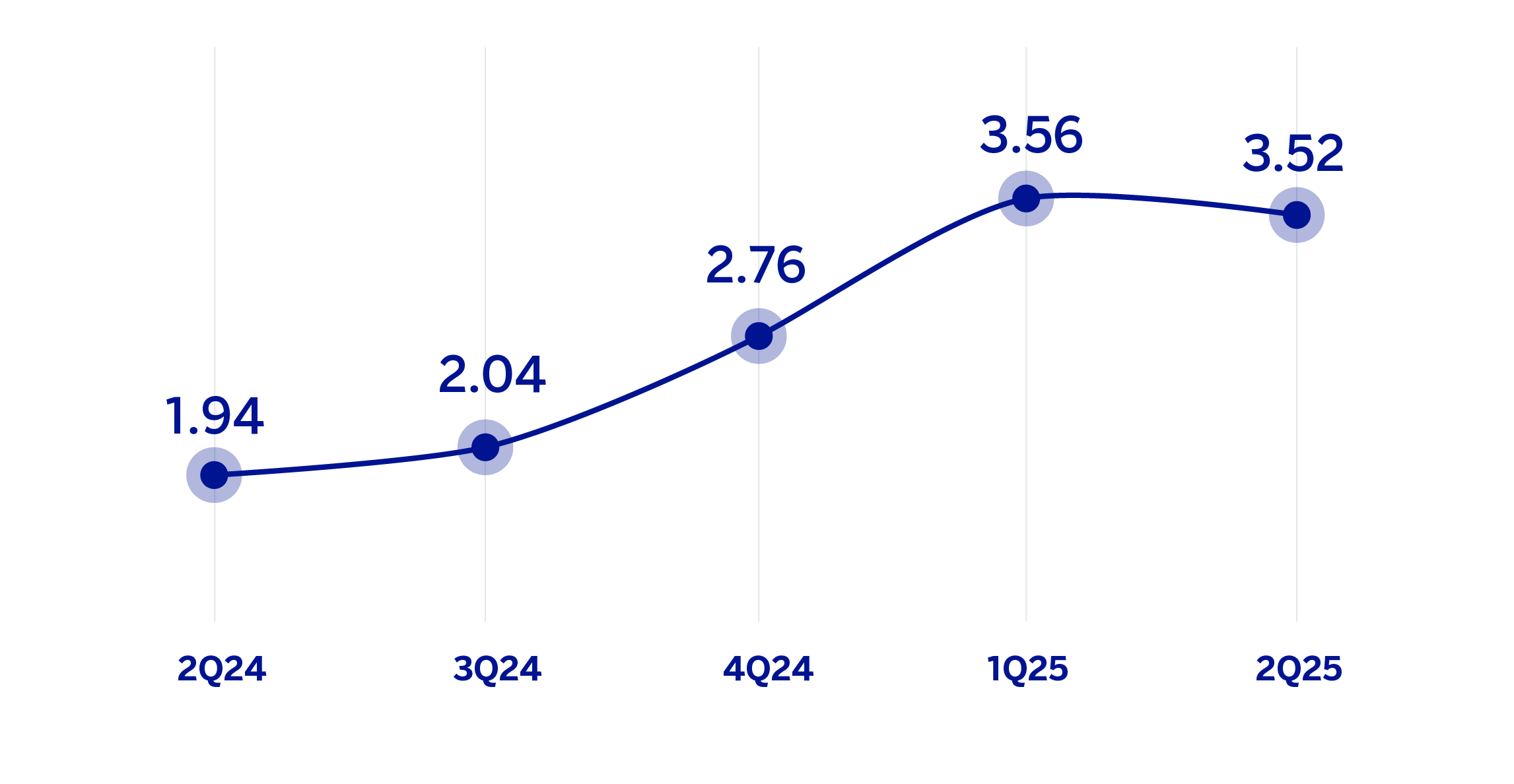
Net interest income grew year-on-year, mainly driven by the dynamism of lending activity and by the improvement of the Turkish lira customer spread. In addition, the central bank has increased the remuneration of certain Turkish lira reserves since February 2024.
Net fees and commissions recorded a significant increase, driven by the solid performance in fees and commissions associated to payment methods, followed by those related to asset management, insurances and guarantees.
Lower NTI, due to the currency positions the area maintains in the derivatives trading, partially offset by higher results from the Global Markets unit.
The other operating income and expenses line had a balance of €-177m, which compares favorably with the previous year. This line incorporates, among others, the loss in the value of the net monetary position due to the country's inflation rate, together with its partial offset by the income derived from inflation-linked bonds (CPI linkers). The net impact of both effects was less negative at the end of the first half of 2025, compared with the same period of 2024. This line also includes the results of the subsidiaries of Garanti BBVA and the evolution of the insurance business, whose contribution was increased in both cases compared to the first half of 2024.
Operating expenses continued growing, mainly due to higher personnel expenses, linked to the growth in the workforce and a salary review in the context of high inflation. On the other hand, general expenses also increased, highlighting the higher advertising expenditures and, to a lesser extent, technology expenses.
Regarding the impairment on financial assets, it increased, which is explained by the growth of the activity and higher requirements in retail portfolios, partially offset by releases in the wholesale portfolio.
The provisions and other results line closed June 2025 at €11m, which are lower than the releases in the same period of the previous year, associated with significant recoveries from wholesale customers and the revaluation of real estate recorded in the first half of 2024.
In the second quarter of 2025, the net attributable profit of Turkey stood at €317m, which represents an increase compared to the previous quarter as a result of the better performance of recurring revenues combined with a lower net impact of inflation (which includes its offset by CPI linkers) and a reduction in the impairment on financial assets. Thus, the cumulative cost of risk as of June 30, 2025 stood at 1.64%, with a 26 basis points decrease in the quarter helped by lower requirements in the wholesale portfolio.
15 The variation rates of loans in Turkish lira and loans in foreign currency (U.S. dollars) are calculated based on local activity data and refer only refer to Garanti Bank and therefore exclude the subsidiaries of Garanti BBVA, mainly in Romania and Netherlands.
Read legal disclaimer of this report.